
DANES Newsletter - January 2024
Happy New Year!
mu gibil hé-da-húl! (Sumerian)
ina šattim annītim libbīkunu lihdû! (Akkadian)
nu=šmaš ki MU.KAM-za dušgarauwanz(a) piškiddu! (Hittite)
ἔτος νέον εὐτυχές! (ancient Greek)
laeta dies! (Latin)
שנה טובה! (Hebrew)
We are excited to issue the 3rd DANES newsletter, and the first of 2024! Our community is growing and the feedback for DANES activities is rewarding and enriching. We hope to continue in this path for 2024, and are excited to share with you more news and information.
Especially interesting are some of the threads that run through this month’s new publications, like the use of social network analysis to analyze the intricate relationship between kings and their elites, the use of linked open data (LOD), the introduction of new research portals, and articles that lower the barrier of entering digital ancient Near Eastern Studies.
Additions to DANES Resources
We would like to thank members of our community who contributed to the DANES Resources this month:
- Eliese-Sophia Lincke, who contributed the Thesaurus Linguae Aegyptiae (Database) and the Coptic Scriptorium (Database)!
Furthermore, eight more resources were added:
- Construction KIT: a review journal for research tools and data services in the humanities (Academic Resource)
- Cuneiform Digital Palaeography Project (Dataset)
- Database of Early Dynastic inscriptions (Database)
- Gardens of the Roman Empire (Database)
- Polychrome Hieroglyph Research Project (Database)
- Text-Fabric (Programming Resource)
- Tracking Colour: Polychromy of the ancient world (Database)
- Zodiac (Database)
DANES Working Groups
MEGA-ALP Elamite task force
The last ancient language processing working group MEGA meeting began with a very informative introduction into Elamite by our group experts. Then we divided into small groups based on parts of speech. This led to an exciting group effort to agree on an ontology for a digital Elamite lemma base, and the first efforts to annotate the dataset. The recordings of all meetings are available in the task force’s organizational document.
Currently, the subgroups are planning weekly meetings throughout the upcoming months for joint annotation sessions. Late comers are still welcome to join: you can get updates by filling out this Google form.
This month MEGA group meeting will take place on Wednesday 31th of January at 15:00-17:00 CET / 16:00-18:00 IST / 09:00-11:00 EST. Each group will present its work thus far, and we will discuss any remaining issues with the ontology.
The DANES happy-hour
A get-together on the DANES discord channel to discuss news in computational studies of the ANE, following up on the monthly newsletter.
As we are still at the height of the winter holidays, the DANES happy-hour will not take place this month. We are excited to see you next month with twice the gossip!
.jpg)
Recent Academic Publications
AI in Museums: Reflections, Perspectives and Applications (book), edited by Sonja Thiel, Johannes C. Bernhardt
This open source edited volume holds papers originally presented in a conference in December 2022, “Cultures of Artificial Intelligence: New Perspectives for Museums”. They discuss the latest issues and applications of AI in museums, including working with generative AI and large language models. While previously the focus of museums has been to build digital databases for their collections, now this curated data can be used with machine learning applications to expand the possibilities of what is done with the data and how museums use it for outreach and visitor experiences. The volume is divided into three sections: Reflections, which includes articles on the advantages and limitations of AI, as well as the ethical issues that come with it, and whether it is “intelligent”; the contributions in the Perspectives section provide insight from case-studies and experiences of using AI in the context of museums, giving information on the conceptual framework needed; the Applications section concludes with a selection of projects implemented in recent years, from artificially curating exhibitions across museums to using chatbots as personalized tour guides, among others.
Building Digital Projects to Outlive Their Funding (journal article, Avar), by Christian Casey
The biggest issue of many digital research projects is longevity and distribution of their results. Using the Zodiac project as a case-study, Casey lists the main avenues given current technologies for hosting websites that display and interact with datasets created in the process of digital projects. He weighs the pros and cons of each, referencing other digital humanities projects that use such solutions. It provides important insight on what questions to ask before creating online resources.
Exploring geomagnetic variations in ancient mesopotamia: Archaeomagnetic study of inscribed bricks from the 3rd–1st millennia BCE (journal article, PNAS), by Matthew D. Howland, Lisa Tauxe, Shai Gordin, Mark Altaweel, Brendan Cych, Erez Ben-Yosef
This interdisciplinary study presents 32 high-resolution geomagnetic intensity data points from royal brick inscriptions written in cuneiform from the 3rd-1st millennia BCE. Thanks to the exact dating of the inscriptions, the geomagnetic data points can be assigned tight date ranges. They reveal the presence of a phenomenon known as the Levantine geomagnetic Iron Age anomaly (LIAA) also in Mesopotamia. The data points support to some extent Low Chronology dating for the region, and significantly enhance available data that can be used as a reference for any future dating applications in Mesopotamian archaeology.
Fragmented-cuneiform-based convolutional neural network for cuneiform character recognition (journal article, IAES International Journal of Artificial Intelligence), by Agi Prasetiadi, Julian Saputra
Prasetiadi and Saputra created an artificial dataset of cuneiform characters based on the visual representations of Unicode cuneiform in the Noto Sans Cuneiform computer font. They added noise to this dataset, meaning, various distortions were performed on the signs, and most importantly they intentionally removed parts of the characters in order to imitate more realistic scenarios of the states of preservation of cuneiform signs. Despite the fact that cuneiform fonts are not always the best representation of cuneiform signs, they show that even with distortions and erasures a neural network can correctly identify cuneiform signs with 83.86% accuracy.
From an Analog to a Digital Workflow: An Introductory Approach to Digital Editions in Assyriology (journal article, Cuneiform Digital Library Bulletin), by Timo Homburg, Tim Brandes, Eva-Maria Huber, Michael A. Hedderich
At the Johannes Gutenberg-Universität Mainz in February 2021, the workshop “Von analog zu digital. Konzeptionen der Keilschriftforschung im 21. Jahrhundert am Beispiel administrativer Urkunden” was held. Its purpose was discussing current issues in the intersection between assyriology, digital humanities, and computer science, particularly from the perspective of young scholars in the field. This article elaborates on the discussions held at the workshop. Its emphasis is on how to reenvision the creation of scholarly editions as digital scholarly editions, following current best-practices, but also includes discussions on the latest technologies from linked open data (LOD) to machine learning and how they can aid assyriological research. The article is targeted for young scholars in assyriology, computer science, and data science, in the hopes of creating understanding between the fields, and highlighting current challenges.
Réseaux de pouvoir en Haute-Égypte: Stratégies sociales et territoriales des notables provinciaux sous le Nouvel Empire (1539-1077 av. J.-C.) (book), by Vincent Chollier
Using social network analysis (SNA), this book tackles important questions regarding the strategies of the provincial elites in Upper Egypt during the New Kingdom, including how they stayed in power and what was their relationship with the Pharaoh. Specifically, Chollier uses the reconstructed networks to reveal changes in the behavior of the elite and puts those changes in their historical context. The use of the networks is key to show how the elites of Upper Egypt changed their strategy in the beginning of the Ramesside period to compete with the Pharaoh over their geographical domain. The book begins with an introductory chapter on the use of graph theory and relational networks in general and their application in Egyptology specifically. The following chapters cover the changes and developments in the relationship between the elites and the royal courts.
The Archaeological Distribution of the Cuneiform Corpus (journal article, Altorientalische Forschungen), by Rune Rattenborg, Gustav Ryberg Smidt, Carolin Johansson, Nils Melin-Kronsell, Seraina Nett
This article provides a first systematic quantitative assessment of certain aspects of the find-spots of writing in the cuneiform world. Spurred by the digitization of cuneiform inscriptions in recent decades, the authors created a geographical metadata index called the Cuneiform Inscriptions Geographical Site index (CIGS). It catalogs locations with reported finds of cuneiform inscriptions at site level across the ancient Near East and beyond, allowing a better appreciation of the scale of written documentation spatially and chronologically. It is based on records from 600 sites and identifies a total of 430,000 inscribed artifacts in them based on secondary literature. Their quantitative and statistical analyses flashed out the use of cuneiform inscriptions as relics in local communities both in the past as well as in more recent history. They also established a decorrelation between site size and amount of cuneiform found there, and they showed computationally where it is likely to find more cuneiform tablets–their results suggest the places to look are in the periphery.
The Decline and Fall of the Assyrian Court Scholar: A Social Network-Based Examination (journal article, Avar), by Christopher W. Jones
The status of scholars in the Neo-Assyrian empire is a question that has been debated extensively in assyriology–particularly, what was their level of influence on the king. This article provides a new perspective on this question through the use of social network analysis (SNA). By assessing graph centrality measures of scholars, derived from the quantity of their correspondences to and fro with the king, Jones shows that during the reign of Esarhaddon there was an inner-group of scholars that enjoyed close relations with the king. However, under Assurbanipal, the number of influential scholars drops significantly, which he attributes to Ashurbanipal’s political motives.
Visualizing Pentateuchal Composition: A New View of the Creation of Ancient Hebrew Literature (journal article, Avar), by Seth L. Sanders, Walker Rhea, Kay White
One of the benefits of the computer age is the flexibility of online interfaces. This article presents the results of a pilot project for a portal of side-by-side editions of different biblical sources. The pilot project focused on displaying the Priestly (P) and non-Priestly sources of the Pentateuch. Users will be able to choose for themselves which verses belong to which sources, testing out their hypotheses in an interactive environment. The article discusses their results thus far and their importance in the context of biblical studies and digital humanities. They provide a step-by-step of how they created their pilot and their plans of future expansion.
Datasets Published
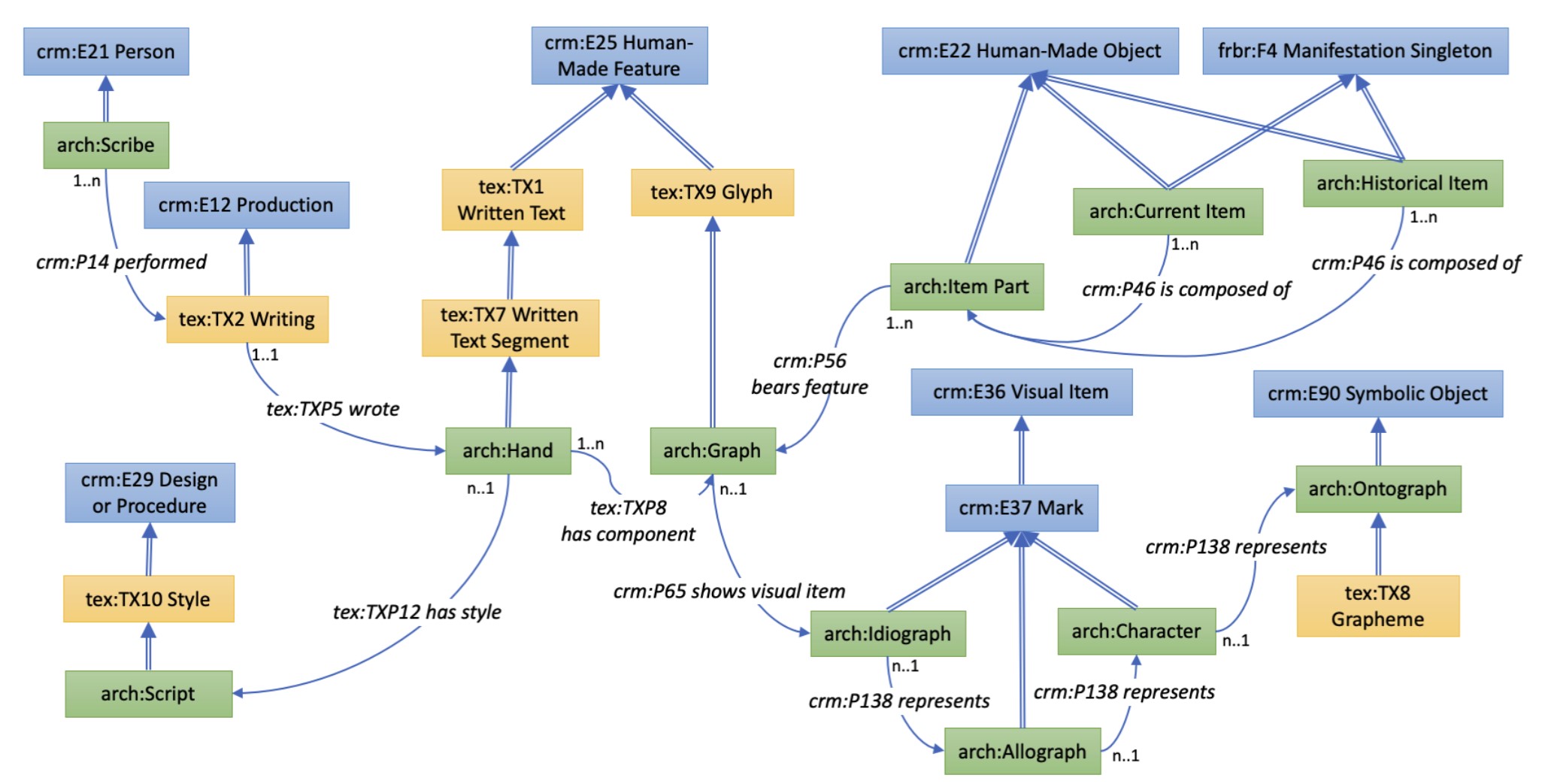
POGO: Philology-Oriented Graphematics Ontology, by Paolo Monella
POGO is a linked open data (LOD) ontology with key concepts for digital philology, particularly for digital scholarly editions of documents written with pre-modern writing systems: see an archetypical representation of the ontology in the figure above. It is an expansion of CIDOC-CRM, an established LOD ontology for representing cultural heritage artifacts. POGO thus expands the framework for interoperability across pre-modern languages and writing systems, and particularly establishes conventions for digital scholarly publications.
Conferences and Call for Papers
Upcoming Events
The 2023/24 Digital History research colloquium of the Humboldt University of Berlin hosts lectures (via zoom) on data modeling, linked open data and AI applications for historical data and research questions.
Four talks are planned for January: Nina Rastinger on Kleine Texte, dichte Daten: Listen in historischen Zeitungen als Schatz für die Digital Humanities (Jan 10); Torsten Hiltmann, Till Grallert, and Claudia Prinz on Von Methoden, Epistemologien und Publikationskulturen im Zeitalter der rapiden Datafizierung der Geschichtswissenschaften (Jan 17); Mia Ridge and Kaspar Beelen on Living with Machines: scaling up historical practice with digital machines (Jan 24); and Anna Siebold on “Where there is no data, there is no network.“ Merkmale, Ideale und Best Practice Kriterien der historischen Netzwerkforschung (Jan 31)
The Digital Classicist Berlin seminar series for 2023/24 will deal with the use of AI in the study of the Ancient World. It will take place on every second Tuesday at 16:00 CET and be broadcasted via Zoom.
Planned talks for January 2024 include Patrick Burns on How to Read Latin like a Computer: A case study of Latin noun chunking with SpaCy (Jan 16), and he will also give a workshop What you need to train a historical-language spaCy model (Jan 17); and Daniel Stökl Ben Ezra on Lösungsansätze und offene Fragen zur Massentranskription historischer Handschriften (Jan 23; see also the article he co-published last month on a similar topic, Enhancing HTR of Historical Texts through Scholarly Editions: A Case Study from an Ancient Collation of the Hebrew Bible)
Agent-based Modelling for Archaeologists (Jan 22 OR Jan 25) is a free online workshop to introduce students and scholars from archaeology, history, heritage studies, anthropology and similar subjects to the methods and implementation of agent-based modeling (ABM). No previous knowledge is required. Participants will receive an introduction to theory and practice of ABM, how to create archaeological simulations, and basic programming skills in NetLogo. More advanced tutorials will be available for those who have more experience with ABM. It is organized by Aarhus University, Leiden University, Landward Research, and Saxion University of Applied Sciences as part of the The Agent-Based Modelling for Archaeologists (ABMA) project.
Call for Papers
Workshop: Generative KI, LLMs und GPT bei digitalen Editionen is part of the annual conference of the “Digital Humanities im deutschsprachigen Raum (DHd-Verband)” (DHd 2024), that will take place on 26th February-1st March in Passau. This call for papers invites experiments in AI on all topics related to digital editions, investigating their potential, limits, problems as well as ethical and theoretical implications. Deadline for contributions is by January 14, 2024 (midnight).
Digital Humanities Congress 2024 will be held in University of Sheffield on 4th-5th September 2024, in person. The Digital Humanities Congress takes place every two years at Sheffield, to promote sharing knowledge, ideas and techniques within the digital humanities. Proposals are welcome on new knowledge and insights gained from using digital methodologies, case studies and best practices with DH tools, and more. Abstracts are due by March 1.
Did we miss relevant articles published in the previous month? Did we miss upcoming events in the next month? Would you like to ensure your news will appear in the next newsletter? Please send us an email at digpasts@gmail.com! Corrections to published Newsletters will be sent via the DANES mailing list.