
DANES Newsletter - June 2026
This month’s publications reflect several converging threads in the field. Annotation — of named entities, cylinder seal motifs, and cuneiform signs — emerges as a central concern, with multiple contributions grappling with how to build reliable, reusable labeled data from ancient textual and visual sources. Alongside this, questions of imaging and legibility recur, from new composite photography methods for cuneiform tablets to motif detection in seal impressions. A broader methodological self-reflection is also visible: two contributions this month, on AI in archaeology and on Wikidata’s coverage of writing systems, step back to critically assess the infrastructures and tools the field increasingly relies on, asking not just what these methods can do but where they fall short. On the events side, the overlap between network analysis, linked data, and historical corpora is particularly well represented this month, with upcoming conferences all addressing how formal methods handle the messiness of historical sources.
Two broader developments in computational archaeology are worth flagging for the community. PCI Archaeology (Peer Community in Archaeology) is a free, open peer-review platform for archaeology preprints, operating independently of traditional journals. Authors upload papers to Zenodo, submit them to PCI Archaeology for open peer review, and — upon recommendation — can publish in the CAA Proceedings, JCAA, or any PCI-friendly journal, or simply leave the paper as a peer-reviewed preprint. This model is now the official peer review pathway for the CAA 2026 proceedings (Vienna); the complete abstract booklet from the conference is already available online.
Recent Academic Publications
Proceedings of the Fifteenth Language Resources and Evaluation Conference (LREC 2026) (conference proceedings, LREC 2026), edited by Stelios Piperidis et al., gathered 944 papers on language resources and evaluation, presented 11–16 May 2026 in Palma, Mallorca. All papers are available through the proceedings link above. The following papers from the main track are of direct relevance to DANES:
- Ancient Greek to Modern Greek Machine Translation: A Novel Benchmark and Fine-Tuning Experiments on LLMs and NMT Models, by Spyridon Mavromatis, Sokratis Sofianopoulos, Prokopis Prokopidis, and Maria Giagkou
- Automatic Suggestions of Supplements in the Herculaneum Papyri: Language Models and RESTful API, by Angelo Mario Del Grosso, Gabriele Giannessi, Simone Zenzaro, and Federico Boschetti
- Gretino: A Greek and Latin Dataset to Benchmark Retrieval Systems in Classical Languages, by Hawau Olamide Toyin, Federico Iezzi, Elia Scapini, Giulio Federico, and Giovanni Puccetti
- The Patrologia Graeca Corpus: OCR, Annotation, and Open Release of Noisy Nineteenth-Century Polytonic Greek Editions, by Chahan Vidal-Gorène and Bastien Kindt
- PREMOVE in LiLa: Integrating Latin Preverbed Motion Verbs with WordNet and VerbNet, by Andrea Farina, Marco Passarotti, Francesco Mambrini, Matteo Pellegrini, Eleonora Litta, and Giovanni Moretti
- RAGE: Roman and Greek Emotions, by Frederick Riemenschneider, Jonathan D. Geiger, Thomas Kuhn-Treichel, and Anette Frank
- Semantic Alignment across Ancient Egyptian Language Stages via Normalization-Aware Multitask Learning, by He Huang
The proceedings also include the Proceedings of the Fourth Workshop on Language Technologies for Historical and Ancient Languages (LT4HALA 2026), edited by Marco Passarotti and Rachele Sprugnoli. They brought together 29 papers on natural language processing (NLP) for historical and ancient languages. The workshop also hosted EvaLatin, an evaluation campaign on dependency parsing and named entity recognition for Latin. All papers are available through the proceedings link above. The following are of direct relevance to DANES:
EvaLatin 2026 papers:
- Classificatio Sine Iactu – That Is, Zero-Shot NERC in Latin, by Luisa Ripoll-Alberola, Fernando Nicolás-Flores, and Francisco Javier Muñoz Acebes
- Contextual Probing for Low-Resource Named Entity Recognition in Latin, by Maria Mihaela Trusca, Mark Depauw, Violet Soen, Ine de Daele, Kevin Verbruggen, and Tim Van de Cruys
- Extending omnes flores for the EvaLatin 2026 Dependency Parsing Tasks, by Hiroshi Matsuda and Masayuki Asahara
- Overview of the Dependency Parsing Task at EvaLatin 2026, by Federica Iurescia, Marco Passarotti, and Rachele Sprugnoli
- Overview of the Named Entity Recognition Task at EvaLatin 2026, by Valeria Irene Boano, Eleonora Litta, and Matteo Romanello
- THIVLVC: Retrieval Augmented Dependency Parsing for Latin, by Luc Pommeret, Thibault Wagret, and Jules Deret
- Transfer Learning for Named Entity Recognition of Classical Latin through LLM Prompting, by Callum Chan
- UppsalaNLP at EvaLatin 2026: Multilingual Parsing for Latin, by Sara Stymne
Other relevant papers:
- Across Generations: A Comparative Analysis of NER for Latin Inscriptions from Classical Machine Learning to LLMs, by Wenhui Cui and Phillip Benjamin Ströbel
- A Layered Annotation Workflow for Semitic Epigraphy, by Tal Bernstein, Shai Gordin, and Letizia Cerqueglini
- A New State-of-the-Art BERT Model for Judeo-Arabic, by Elisha Rosensweig, Yitzchak Lindenbaum, Hillel Gershuni, Vered Raziel-Kretzmer, Daniel Caine, and Avi Shmidman
- BEReshiT: an Ancient Hebrew Model based on DictaBERT, by Iglika Nikolova-Stoupak, Maxime Amblard, and Frédérique Rey
- Building a Corpus and Database for Rare and Undeciphered Scripts, by Beata Megyesi, Rune Rattenborg, Benedek Láng, Michelle Waldispühl, and Mihály Héder
- Cost-Aware Pre-Annotation Strategies for Nested NER in Historical Latin Notarial Deeds, by Charlene Ellul, Vanessa Buhagiar, Claudia Borg, and Charlie Abela
- Domain-Aware Error Correction for Citation NER in Medieval Hebrew Responsa, by Shmuel Liebeskind, Maayan Zhitomirsky-Geffet, Binyamin Katzoff, Nati Ben-Gigi, and Jonathan Schler
- Evaluating Hierarchical Aggregation and LLM-Based Matching for Synset Selection in Ancient Greek, by Luca Brigada Villa, Marco Passarotti, Chiara Zanchi, Riccardo Ginevra, Erica Fratellini, and Eleonora Litta
- From Lemmas to Links: A Lemma Bank for Ancient Greek, by Colin Swaelens, Francesco Mambrini, and Marco Passarotti
- From Lemmatization to Legal Terminology: Assessing a Hybrid Pipeline on Justinian’s Digest, by Paola Marongiu and Eva Sassolini
- I, RE:Claudius 256: Towards Linking Classical Latin Person Mentions to a Domain-specific Knowledge Base, by Marijke Beersmans, Evelien de Graaf, Julie Nijs, Valeria Irene Boano, Alek Keersmaekers, Mark Depauw, Tim Van de Cruys, and Margherita Fantoli
- Language Models for the Restoration of Latin Legal Manuscripts, by Shibingfeng Zhang, Edoardo Caraffa, Annafelicia Zuffrano, Maddalena Modesti, and Giovanni Colavizza
- Neural Machine Translation for Coptic-French: Strategies for Low-Resource Ancient Languages, by Nasma Chaoui and Richard Khoury
- The UD_Latin-PROIEL as Linked Open Data: Integrating a Latin Treebank into the LiLa Knowledge Base, by Lucas Consolin Dezotti, Marco Passarotti, Federica Iurescia, and Giovanni Moretti
The Digital Classics Online journal has released a new thematic issue (vol. 12.2, 2026) on Nomina Omina: Ancient Greek and Latin Proper Names in the Age of Artificial Intelligence, edited by Monica Berti. The issue focuses on named entity recognition (NER), annotation, and linked open data (LOD) approaches to proper names–personal names, place names, and divine names–across ancient Greek, Latin, and related corpora. Articles include:
- Nomina Omina: Ancient Greek and Latin Proper Names in the Age of Artificial Intelligence, by Monica Berti
- Naming Latin Texts in the Thesaurus linguae Latinae Index of Sources, by Adam Gitner
- Daidalos: NER for Literary Studies on Latin and Ancient Greek Texts, by Andrea Beyer
- Opera Graeca Adnotata: Building a 40M+ Token Multilayer Corpus for Ancient Greek, by Giuseppe G. A. Celano
- Automatic Annotation of Nomina Sacra, Carina Geldhauser
- Greek and Latin Proper Names in Georgian Scholarship: Epigraphic, Lexicographic and Encyclopedic Traditions, Their Standardisation and Digitisation, by Irine Darchia
- Hypotheseis, a Database of Named Entities Surrounding Greek Rhetorical Exercises, by Camillo Carlo Pellizzari di San Girolamo
- Annotating Named Entities in the Trilingual Inscription at Ka’ba-ye Zartošt (ŠKZ), by Farnoosh Shamsian and Monica Berti
- LGPN-Ling for the Preservation of Greek Personal Names in a Digital Environment, by Matilde Garré
- Altinum: a Wikidata Project for Digital Epigraphy and Prosopography, by Anna Clara Maniero Azzolini
- Digital Mapping of Toponyms in Paradoxographical Texts: The Case of the Paradoxographus Florentinus, by Pietro Zaccaria and Monica Berti
- More than Names? Challenges and Opportunities for Ancient Named Entity Recognition, by Chiara Palladino
- The NIKAW Project: An Infrastructure of Texts, Entities and Language Models to Study the Circulation of Knowledge in the Ancient World, by Margherita Fantoli, Marijke Beersmans, Jens Bürger, Evelien de Graaf, Mark Depauw, Alek Keersmaekers, Bart Thijs, Tim Van de Cruys, and Toon Van Hal
- Detecting Eastern and Western Names in the Latin Corpus of the SERICA Project – With Special Regard to the Confucius Sinarum Philosophus (1687) as a Case Study, by Andrea Balbo and Elisa Della Calce
Advances in Digital Archaeology: Proceedings of the 2023 conference Computer Applications and Quantitative Methods in Archaeology – 50 years of synergy (edited volume, Sidestone Press), edited by J.W.H.P. Verhagen, J. Waagen, A. Brandsen, A. Queffelec, R.M. Visser, and D. Taelman, presents 27 chapters from the 50th annual Computer Applications and Quantitative Methods in Archaeology (CAA) conference, held in Amsterdam in April 2023. Contributions cover a broad range of computational methods applied to archaeological data, including artificial intelligence (AI)-based artifact classification, machine learning for imagery analysis, 3D reconstruction and visualization, geographic information systems (GIS) and spatial modeling, social network analysis, digital archiving, and coin hoard analysis. The volume is available free to read online under a CC BY 4.0 license.
An Assessment of Wikidata on Premodern Writing Systems (article, Journal of Open Humanities Data), by Paul C. Dilley, provides an exploratory evaluation of the scope, consistency, and suitability as a research resource of Wikidata’s 310 writing system items. Using cuneiform, Aramaic, Greek, Brahmi, and Mayan hieroglyphs as representative case studies, the author systematically assesses the most common Wikidata properties applied to writing systems. Key findings include: fewer than a third of items record which languages use the script; citation practices are poor, often relying on outdated open-access encyclopedias; many critical properties such as location of creation and Unicode range are missing from the majority of entries; and different contributors use different properties to express the same relationship, preventing systematic querying. The article concludes with a call for the creation of a Wikidata EntitySchema for writing systems to standardize annotation practices.
Ancient Egypt: New Technology (edited volume, UniorPress), edited by Stefania Mainieri and Rosanna Pirelli, presents 19 contributions from the second International Conference Ancient Egypt – New Technology, held at the University of Naples “L’Orientale” in July 2023. The volume covers a wide range of digital and computational approaches to Egyptological research, organized around five broad methodological clusters: 3D documentation and photogrammetry; geographic information systems (GIS) and landscape analysis; computational text analysis; material and archaeometric analysis; and digital publishing and databases. The volume is freely available online under a CC BY 4.0 license.
Archaeology & Artificial Intelligence (article, Quaderni di Vicino Oriente XVIII), by Lorenzo Nigro, is a ten-chapter critical essay assessing the role of artificial intelligence (AI) in archaeological research. It reviews the main application areas: remote sensing and LiDAR-based site detection, artifact classification, pottery typology, 3D reconstruction, epigraphy and optical character recognition (OCR), robotics, and generative AI. It demonstrates the value and methodological limits in each. The essay’s central argument is the irreducibility of historical interpretation to data processing: AI can accelerate, classify, and visualize, but cannot reconstruct stratigraphic context or revise the provisional categories on which archaeological knowledge depends. Later chapters address the opacity of machine learning models, bias in training data, dual-use risks of archaeological spatial data, and dependence on private computational infrastructures.
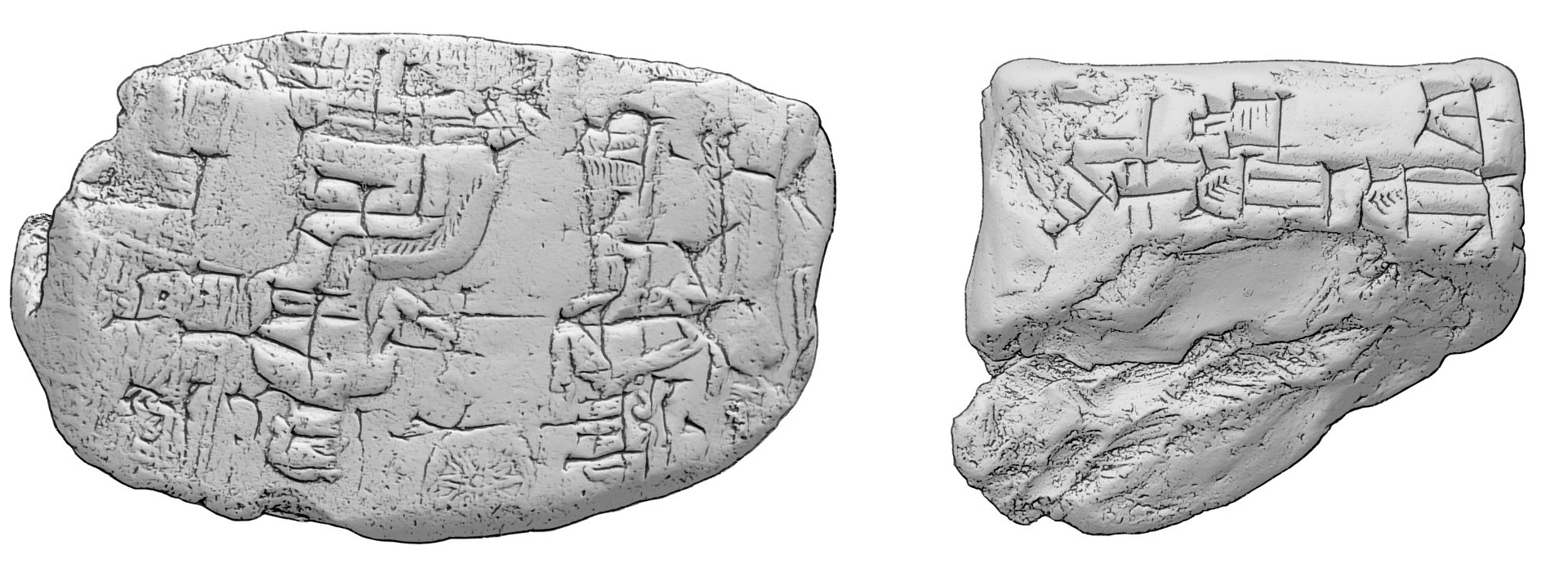
Improving Legibility: Visual Strategies for Four Unpublished Cuneiform Objects from Ghent University (article, Cuneiform Digital Library Bulletin), by Mirko Surdi, presents a new imaging method applied to four previously unpublished cuneiform objects from the Ghent University Museum. By combining two different filter options from the outputs of the Portable Light Dome (PLD), which creates 2D+ images, the resulting composite images make cuneiform signs and seal impressions significantly easier to read while preserving the physical characteristics of the objects. The method proves especially effective for publication, producing clear and legible images suitable for both print and digital formats.
Visual Analysis of Cylinder Seal Impressions and Unwrappings: Annotation and Automation (article, Cuneiform Digital Library Bulletin), by Lara Bampfield, Jacob L. Dahl, Abhishek Dutta, and Andrew Zisserman, showcases a workflow for annotating and automatically detecting motifs in cylinder seal images held by the CDLI. Using VIA, an open-source browser-based tool for drawing labeled regions on images, 469 Old Babylonian cylinder seal impressions from the British Museum were manually annotated, marking motifs such as king, deity, worshiper, and throne with structured labels drawn from Getty Art & Architecture Thesaurus vocabulary. These annotations enable two applications: a spatial analysis tool that aggregates motif positions across hundreds of unwrappings to reveal consistent compositional conventions (for example, disc and crescent motifs cluster in the upper half of seal scenes while throne and footrest appear in the lower half), and an automated figure detector fine-tuned from a pre-trained neural network on 2,491 annotated examples, achieving 94% accuracy and successfully tested across collections at the Ashmolean, Leiden, and the Bibliothèque Nationale de France. All annotations, trained models, and software are released as open source.
Special Mention
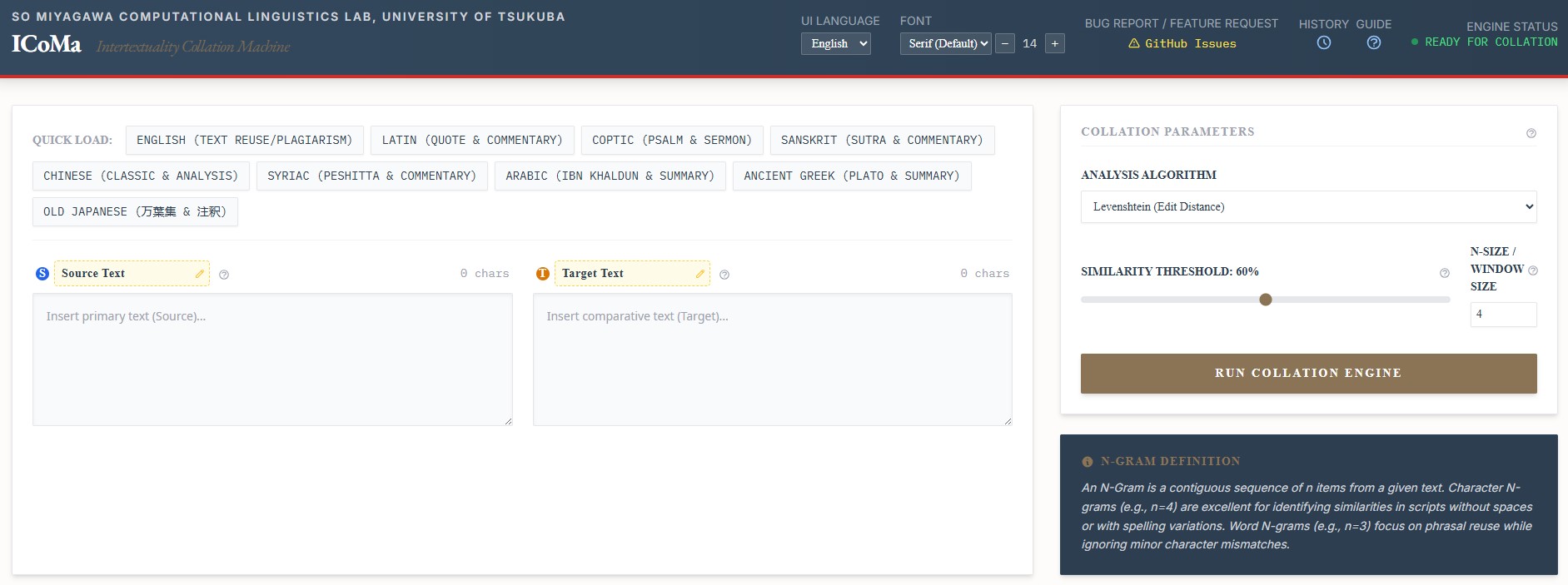
ICoMa (Intertextuality Collation Machine) (web tool), developed by So Miyagawa at the Computational Linguistics Lab, University of Tsukuba, is a free, browser-based tool for detecting and visualizing text reuse, intertextuality, and computational collation across multilingual corpora. It supports a wide range of scripts directly relevant to DANES, including Arabic, Hebrew, Syriac, Ancient Greek, Coptic, and Latin, as well as Sanskrit, Chinese, and others. Users can compare two texts using four algorithms: Jaccard similarity, Smith-Waterman local alignment, Levenshtein edit distance, and n-gram matching, and explore results through six visualization modes: alignment flow, parallel viewer, network graph, dispersion plot, similarity histogram, and heatmap. The tool requires no installation, and the source code is available on GitHub under a CC BY 4.0 license.
Datasets Published
Geochemical Data of Maiolica Chert from Central Italy for Provenance Studies (Journal of Open Archaeology Data), by Elena Carletti, Ignazio Allegretta, Luca Forti, Roberto Terzano, and Giacomo Eramo, collected the geochemical characterization of 97 chert samples from six primary outcrops of the Maiolica Formation (Jurassic–Cretaceous) across the Umbria-Marche succession in central Italy (Abruzzo, Latium, and Umbria regions). Each sample was analyzed using portable X-ray fluorescence spectroscopy (pXRF), quantifying 11 elements (Sr, Rb, As, Zn, Ni, Fe, Ti, Ca, K, Mn, and Ba), and documented with stereomicroscope microphotographs at 10× and 20× magnification. The dataset is intended for provenance analysis of chipped stone artifacts regardless of archaeological context or chronology, and complements a previously published characterization of Scaglia Bianca Formation chert from the same region. The data are available on Zenodo as a CSV file and photo archive under a CC BY 4.0 license; physical samples are accessible on request.
Geospatial and Lithological Data on Roman Stone Monuments from Southeastern Slovenia (Journal of Open Archaeology Data), by Edisa Lozić, created a georeferenced and lithologically classified catalog of 194 Roman stone monuments from southeastern Slovenia (Lower Carniola and Bela Krajina), dated primarily to the 1st–4th centuries CE. Records cover funerary stelae, votive altars, inscription plaques, milestones, and architectural elements, and include typological classification, spatial coordinates, monument dimensions, epigraphic information, bibliographic references, and macroscopic lithological attribution based on petrographic analysis. The dataset is available on Zenodo as a CSV file under a CC BY 4.0 license, and is further accessible through the EOLITH online atlas, an interactive searchable interface for spatial and thematic exploration of the monument records.
Multidisciplinary Study of Lime and Gypsum Plasters from the Paphian Region – Comprehensive Dataset (Journal of Open Archaeology Data), by Paola Pizzo and Jan Válek, presents a multi-analytical characterization of 100 lime and gypsum plaster samples from four archaeological sites in southwestern Cyprus spanning the Late Bronze Age through the Roman period (ca. 1600 BCE–400 CE). The dataset integrates results from a wide range of material analysis techniques, covering mineralogical composition, microstructure, binder characterization, pigment identification, and organic residue analysis. These methods were applied to masonry mortars, waterproofing mortars, wall plasters, and floor structures. The dataset is available on the Czech Academy of Sciences repository.
Peshitta Constellations (Zenodo), by Jossi Fresco is a web-based root explorer and interlinear reader for the New Testament Peshitta (Syriac), with cross-Semitic cognate mapping to Hebrew and Arabic. The dataset covers 101,469 word tokens across the traditional 22-book Peshitta canon, with triliteral and biliteral root extraction yielding 2,532 roots, of which 436 are mapped to Hebrew and Arabic cognates (3,459 cognate words), drawn from the ETCBC/syrnt corpus. It supports a range of search and visualization functions, including keyword-in-context (KWIC) concordance, co-occurrence search, semantic field browsing across 20 thematic categories, and translation shift analysis from Aramaic through Greek to modern languages. Bulk exports are available in USFM 3.0, OSIS 2.1.1 XML, and Text-Fabric formats; the source code is openly available on GitHub and a live application is hosted at peshitta.onrender.com.

Events
Talks and Conferences
The Institute of Classical Studies in London is offering talks in the upcoming months that are of interest to the DANES community:
- 26 June, Federico Di Pasqua (University of Zurich): GraphRAG and the Ancient World: Toward a Spatial AI Research Platform
- 17 July, Burak Boşdurmaz (University of Koç): Mapping the Blue Horizon: A Digital Corpus Approach to the ‘Caeruleus-Glaucus’ Complex in Classical Latin Literature
- 31 July, Jesse Obert (University of South Florida): Warriors without War on Archaic Crete: Testing Paradigms with Big Data and Social Network Analysis
The International CLaDA-BG Conference 2026 on Language Technologies and Digital Humanities: Resources and Applications (LTaDH-RA) will take place 25–26 June in Sofia, Bulgaria, organized by the Bulgarian national research infrastructure for language, cultural and historical heritage integrated within DARIAH. The conference brings together natural language processing (NLP) developers, linguists, and digital humanities scholars working on knowledge modeling and linked data, covering topics including language technologies for historical texts, large language models (LLMs) in digital humanities, knowledge graphs for social sciences and humanities research, semantic technologies, and the role of digital libraries and archives. Attendance is free of charge; a conference dinner is available for 30 euros. Registration is open.
The Cultural Complexity and Computational Approaches (CCCA) – Complexhibit 2026 Conference will take place 30 June–2 July in Málaga, Spain. The conference addresses the study of cultural ecosystems as complex systems, bringing together network science, knowledge graph and ontology construction, natural language processing (NLP) for historical corpora, simulation and generative modeling, and questions of data governance and epistemic accountability. The program includes paper presentations, panels/roundtables, and hands-on workshops on Day 1, as well as a dedicated session on FAIR, CLARIN, and DARIAH research infrastructures. Attendance is free of charge; see the conference website for details.
The Historical Network Research Conference 2026 (HNR2026) will take place 20–22 July in Turin, Italy. This year’s theme, Networks and their Sources, focuses on the opportunities and limitations that historical sources — archival documents, archaeological remains, correspondence, print media, and others — present for formal network research. The program includes 38 long papers and 26 short papers across 20 sessions, 2 keynotes, a round table, and a pre-conference nodegoat workshop. Sessions span a wide range of periods and methods, including Middle Kingdom Egypt and co-occurance networks in Ancient Greek and Latin text. A free pre-conference workshop on historical network analysis using nodegoat will be led by its creators Pim van Bree and Geert Kessels (separate registration required via this form). Attendance is free; conference registration is required.
DH2026 is the 36th annual conference of the Alliance of Digital Humanities Organizations (ADHO), taking place July 27–31, 2026 at the Daejeon Convention Center in Daejeon, South Korea and online, around the theme of “Engagement.” The full program is available as an interactive agenda and printable PDF; registration is open via the conference website. Of particular interest to the DANES community is the AI4AS 2026 (AI for Ancient Studies) mini-conference on July 27, which critically examines the opportunities and risks that generative AI introduces into the study of ancient non-alphabetic languages, with a focus on the methodological vulnerabilities of low-resourced corpora, LLM distortion of primary sources, and the development of responsible-use guidelines for AI in ancient language research. Registration for remote participation in the workshop is available and free of charge.
The Connected Past 2026 conference will take place 22–25 September at the University of Toronto, Canada. The conference focuses on network science and theory applied to archaeology and history, covering topics including past spatial and social networks, mobility and connectivity, incomplete data in network studies, multivariate methods, and communities of practice. The program opens with a network science workshop (capped at 25 participants) covering practical methods in RStudio, Gephi, and Visone, followed by two and a half days of paper and poster sessions. Registration is open; early bird rates (until 30 June) are CA$125 for regular and CA$75 for students; late registration (until 21 August) is CA$150 and CA$90 respectively.
Training Opportunities
Syriaca.org and the Digital Lab at Vanderbilt University are offering a free virtual workshop on Digital Encoding for the Study of Syriac Literature, running across five live sessions from 29 June to 9 July 2026 (10:00 AM–2:00 PM EDT), with approximately 20 hours of synchronous and 20 hours of asynchronous activities. Participation is free of charge. The workshop covers TEI XML encoding using the Syriaca.org data model, collaborative DH tools including XML editors and GitHub, linking data to the Syriaca.org knowledge graph, and an introduction to using AI with Syriaca.org resources, with this year’s sessions oriented around the New Handbook of Syriac Literature. The workshop is aimed at researchers, graduate students, faculty, librarians, and technologists with at least beginning Syriac reading ability; no prior encoding experience is required. Participants who complete the workshop receive a letter of completion, and a limited number of $500 stipends are available for those who go on to contribute as editors to Syriaca.org, with preference given to students and early career scholars. Continuing education credit through Vanderbilt is available for a modest fee. Applications are accepted on a rolling basis via the application form until the workshop is full.
The H-Net Spaces Cohort Program is offered by H-Net (Humanities and Social Sciences Online), a free scholarly infrastructure platform hosting interdisciplinary networks, discussion lists, and open-access digital projects for the global humanities and social sciences community. The Cohort Program supports scholars in building open-access digital projects on the H-Net Commons platform, with a particular focus on early-stage projects and scholars seeking hands-on training in digital humanities methods. Accepted participants receive up to $500 in seed funding, hands-on training in digital project development, monthly training and co-working sessions, and the opportunity to present their completed project at a virtual roundtable at the end of the cohort cycle. The program especially welcomes proposals from early career scholars, graduate students, contingent faculty, and interdisciplinary or multimodal projects. H-Net Spaces provides tools for uploading and organizing digitized documents, media, and data, with support for visualizations including timelines, GIS maps, and image libraries. The program accepts 4–5 projects per year. Applications are due 1 July 2026, with decisions communicated by early August; apply via the application form.
EPC Treebank Training School: Annotating Earlier and Classical Egyptian Texts is a free online training school running September 1–11, 2026 (Monday–Friday, 17:00–19:00 Madrid time), aimed at postgraduate students. Participants learn to annotate Earlier and Classical Egyptian texts within the EPC Treebank using the Universal Dependencies (UD) framework, directly contributing new material to the treebank (currently 3,089 sentences from the Pyramid Texts); credited annotators receive a certificate upon completion. Admission is selective: submit a CV and motivation statement (max 500 words) proposing a text for annotation to radiaz@ujaen.es. Applications open June 1–July 7, 2026.
Call for Papers
The Journal of Open Humanities Data (JOHD) is accepting submissions for a Special Collection titled Weathering the Storm: Opportunities and Challenges in Data Rescue and Safeguarding, focused on the preservation of humanities data under threat from funding cuts, censorship, conflict, cybersecurity risks, and AI-driven data pollution. The collection invites contributions from researchers, librarians, archivists, curators, and data stewards on topics including digitisation of at-risk physical materials, institutional and community safeguarding initiatives, methods for protecting data against disinformation and cyberattack, financial sustainability, and ethical considerations around indigenous knowledge and curatorial bias. Both short data papers (1,000–1,500 words) describing specific rescued or at-risk datasets, and longer discussion papers (3,000–5,000 words) on methods and challenges in data rescue and safeguarding, are welcome. Publication fees apply, with waivers available. Abstracts of up to 300 words should be submitted via this form. Expression of interest deadline was 31 May 2026, but the form is still receiving abstracts; full papers are due 7 September 2026.
The 23rd EUROGRAPHICS Workshop on Graphics and Cultural Heritage (GCH 2026) will take place 2–5 November in Barcelona, Spain, hosted by the Universitat Politècnica de Catalunya (UPC). The workshop is a key venue for interdisciplinary research at the intersection of computer graphics, AI, and cultural heritage, covering topics including 3D digitization, multispectral imaging, material reconstruction, extended reality, multimodal analysis, semantic technologies, and FAIR visual datasets. A dedicated ECCCH track (European Collaborative Cloud for Cultural Heritage) invites submissions on visual computing methods aligned with the European Collaborative Cloud for Cultural Heritage. The workshop accepts full papers (up to 10 pages), short papers (up to 4 pages), and posters/demos (2 pages); selected contributions will be invited for extended publication in ACM JOCCH or Elsevier DAACH. Full paper submission deadline was 1 June 2026; short papers, posters, and ECCCH submissions are due 22 July 2026.
Transformations: A DARIAH Journal invites proposals for guest-edited special issues, published alongside its annual regular thematic issue. Proposals are welcome from individuals or teams from any institution or country, including interdisciplinary and cross-sector editorial teams. Submissions should make a clear scholarly case for a focused theme, identify an engaged author and reader community, and demonstrate realistic editorial capacity. Multilingual special issues are explicitly welcomed, in English, in another language, or in multiple languages, subject to the same peer review and editorial standards as regular articles. Proposals should be submitted as a completed template form in PDF to transformations@episciences.org with the subject line “Special Issue Proposal”. Accepted proposals will move into a call for papers and contribution preparation phase from July 2026, with peer review in summer 2027 and target publication in December 2027. Proposal deadline is 30 June 2026.
The Computational Humanities Research Conference 2027 (CHR2027) will take place 5–8 January 2027 at the University of Manchester, hosted by the Centre for Digital Humanities, Cultures and Media, with a virtual participation option available. CHR is the main annual venue for computational and quantitative approaches to humanities research, covering topics including machine learning for humanities data, hypothesis-driven research and generative models, evaluation methods and standards, modelling bias and uncertainty, and the potential and challenges of AI in humanities research. The conference accepts long papers (up to 6,000 words), short papers and posters (up to 3,000 words), lightning talks (750-word abstract), and workshop proposals (up to 1,500 words) for pre-conference workshops on 5 January. Submissions must be anonymised and formatted using the ACL LaTeX template, submitted via EasyChair. Accepted papers will be published in the Anthology of Computers and the Humanities. Submission deadline is 14 August 2026.
Fellowships, Scholarships, and Job Opportunities
Tenure Track Professor of Computational Humanities, University of Graz is a tenure track position at the Department of Digital Humanities, Faculty of Humanities, University of Graz, Austria. The position begins as a 6-year fixed-term Assistant Professorship, converting to a permanent Associate Professor upon successful completion of the qualification agreement. The role covers computationally and mathematically oriented methods applied across humanities disciplines, including cultural heritage, historical sciences, and linguistics. Applicants must hold a doctorate in digital humanities, a humanities subject using digital methods, or computer science with a humanities focus, along with several years of postdoctoral experience. The Department of Digital Humanities is one of the leading institutions in the field in Austria, with research spanning digital representations of cultural objects, Digital Humanities (DH) infrastructures, and the application of data science and artificial intelligence to humanities research data. Application deadline is July 1, 2026.
Did we miss relevant articles published in the previous month? Did we miss upcoming events in the next month? Would you like to ensure your news will appear in the next newsletter? Please send us an email at digpasts@gmail.com! Corrections to published Newsletters will be sent via the DANES mailing list.