
DANES Newsletter - September 2024
This fall we are returning after the summer hiatus to the monthly DANES newsletter with a torrent of new publications, as well as two new digital humanities journals! Computational Humanities Research published by Cambridge, and Journal of Digital Islamicate Research published by Brill.
The annual DANES conference will take place online in early December 2024. We are accepting submissions until the end of this month. We look foreward to see DANES member submissions, and also hope that you share the call for papers far and wide to extend our growing community.
Several conferences are taking place this coming month, and we are excited to see that we all share a common theme: digitization and sharing data, as well as instruction on how to access digital and online collections of (ancient) texts and artifacts.
DANES 2024 Conference
We are excited to announce that the second Digital Ancient Near Eastern Studies conference (#DANES24) will take place as a virtual event on 5-6 December 2024 during the afternoon hours CET.
This year’s theme is “Digital Resources of the Ancient Near East: Creation, Application Studies, and Maintenance”. We particularly invite talks on using and expanding digital datasets and databases related to the ancient Near East, as well as talks on the creation, maintenance, and development of such resources.
We invite submissions of long talks (20 minutes), short talks (10 minutes), poster presentations, and workshops (90 minutes). Long talks will be published in a peer-reviewed journal and short talks, posters, and workshops will be published on the peer-reviewed OpenDANES platform.
The conference will also include keynote speakers Caroline T. Schroeder (University of Oklahoma) and Amir Zeldes (Georgetown University) of the Coptic Scriptorium project. In addition there will be a Q&A session and virtual hangout sessions.
Full details on the conference and constant updates can be found at the conference website. Abstract submission is through this Google Form.
Looking forward to seeing you virtually!
Recent Academic Publications
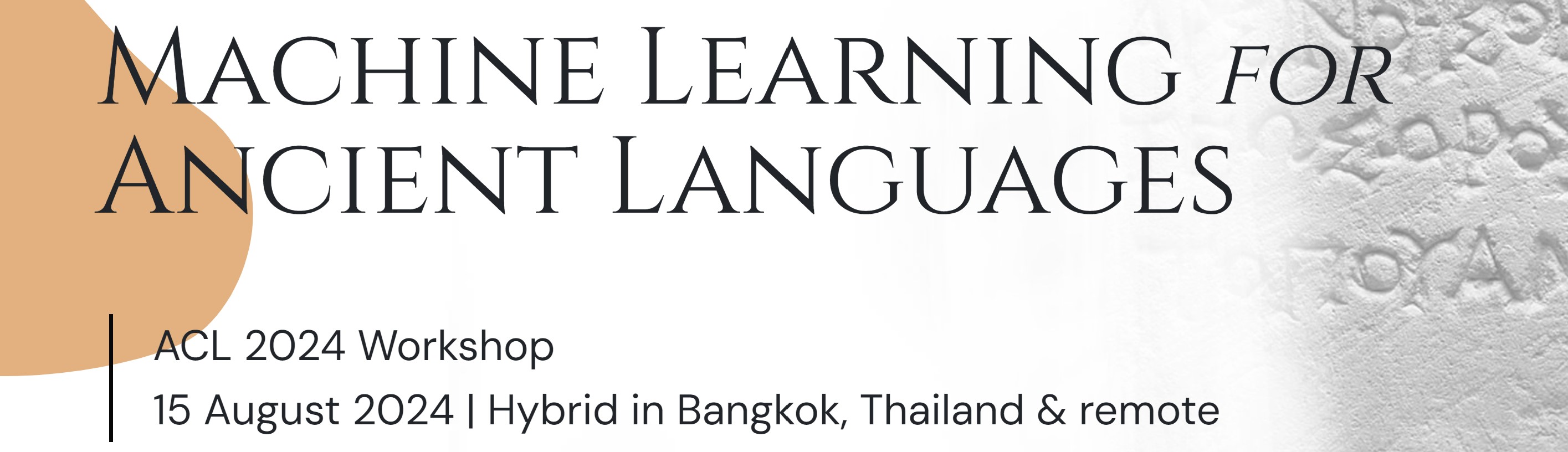
Proceedings of the 1st Workshop on Machine Learning for Ancient Languages (ML4AL 2024) (conference proceedings, Association for Computational Linguistics 2024), edited by John Pavlopoulos, Thea Sommerschield, Yannis Assael, Shai Gordin, Kyunghyun Cho, Marco Passarotti, Rachele Sprugnoli, Yudong Liu, Bin Li, and Adam Anderson, are the results of an interdisciplinary meeting between machine learning experts and scholars of ancient languages, that took place at the Association for Computational Linguistics (ACL) 2024 conference, the flagship computational linguistics and NLP conference. On its first year, ML4AL received 50 submissions from a global community of researchers, out of which it accepted 18 papers and 10 posters after a peer-review process. The submissions concern multiple languages of relevance to the DANES community, including Ancient Greek, Latin, Sumerian and Akkadian, ancient Egyptian, Coptic, etc. The accepted submissions cover the digitization, restoration, attribution, linguistic analysis, textual criticism, translation, and decipherment of ancient texts. The combination of languages and computational methodologies means that every member of the DANES community can find something of interest in the proceedings.
Furthermore, the main track of ACL 2024 also included papers on comparing the visual and textual representations of ancient logographic writing systems including cuneiform texts, and machine translation of Coptic.
Better Low-Resource Machine Translation with Smaller Vocabularies (conference paper, Text, Speech and Dialogue TSD 2024 Lecture Notes in Computer Science), by Edoardo Signoroni and Pavel Rychlý, offers new practical insight into training transformer models for machine translation of low-resource languages. They show that using significantly smaller vocabularies (1k tokens as opposed to the default 32k) improves performenace as well as being significantly smaller models and faster to train. The test sets used in this article include English-Akkadian, among others.
Computational methods for undeciphered scripts (book), by Michele Corazza, is an open access publication discussing computational approaches (constraint programming and deep learning models) used for the decipherment of Linear A and Cypro-Minoan writing systems, and the results thereof. It proposes a decipherment of Linear A fractions, as well as suggesting that the three Cypro-Minoan writing systems previously hypothesized are in fact one writing system.
Letters have weight: weighted k-shells in a Neo-Assyrian co-attestation network (article, Journal of Historical Network Research), by Ellie Bennett, Lena Tambs, and Krister Lindén, uses network centrality measures (k-core centrality) to identify elite groups during the reign of Sargon II (721-705 BCE). Through a network created by co-attestations of individuals in the correspondence of Sargon II, they found elite groups which align with previous assyriological research and shows the potential of this method for the field.
Seeing is believing – The application of Three-Dimensional modelling technologies to reconstruct the final hours in the life of an ancient Egyptian Crocodile (article, Digital Application in Archaeology and Cultural Heritage), by L.M. McKnight, R. Bibb, and F. Cooper, CT scanned a crocodile mummy and discovered its last meal–a small fish and a bronze fish hook. They were able to create a virtual model of the fish hook, as well as wax and bronze replicas. They also discuss the biological biography of the crocodile, the human-animal relations apparent therefrom, and the benefits using the techniques in this article for interpretation, preservation, and accessibility.
Social group identities and semantic domains in the ancient Near East (article, Digital Scholarship in the Humanities), by Krister Lindén, Saana Svärd, Tero Alstola, Heidi Jauhiainen, Sam Hardwick, Aleksi Sahala, Céline Debourse, Ellie Bennett, Lena Tambs, Melanie Wasmuth, Elisabeth Holmqvist, Rick Bonnie, Marta Lorenzon, summarizes years of work and research at the Centre of Excellence in Ancient Near Eastern Empires (ANEE) at the University of Helsinki. They present an overview of automated language processing for lexical-semantic analysis, social network analysis, and content analysis, as part of their efforts to address how changing empires affect social group identities and lifeways in the first millennium BCE in Mesopotamia.
A Systematic Review of Computational Approaches to Deciphering Bronze Age Aegean and Cypriot Scripts (article, Computational Linguistics), by Maja Braović, Damir Krstinić, Maja Štula, and Antonia Ivanda, provides a thorough review of major Bronze Age Aegean and Cypriot scripts, their relevant digital data and corpora, and existing computational decipherment methods; definition of 15 major challenges encountered in computational decipherments of ancient scripts; and an outline of a computational model that could be used to simulate traditional decipherment processes of ancient scripts based on palaeography and epigraphy.
Techné of Rock Engravings—the Timna Case Study (article, Journal of Archaeological Method and Theory), by Lena Dubinsky and Leore Grosman, uses the ArchCUT3-D software, developped and described by the authors in a previous article, for computational analysis of 3D data acquired from various rock engravings located in Timna Park, southern Israel. They decode technical trends and variabilities in a carving technique’s particular implementation, and focus on one group engraved figures in order to establish a link between execution techniques and visual considerations.
Special Mention
Spracherkennung - Küntliche Itelligenz entziffert Keilschrift (podcast, Deutschlandfunk), by Volkart Wildermuth, discusses how AI has accelerated the decipherment of the countless cuneiform tablets stored in museums around the world, such as everyday documents, like tax files or contracts, but also literature, like hymns and epics. Featuring many colleagues in the field of cuneiform texts (in alphabetical order): Adrian Cornelius Heinrich (FSU Jena); Johannes Hackl (FSU Jena); Enrique Jiménez (LMU Munich); Hubert Mara (FU Berlin); Émilie Pagé-Perron (Oxford); Karen Radner (LMU Munich); Fabian Simonjetz (LMU Munich).
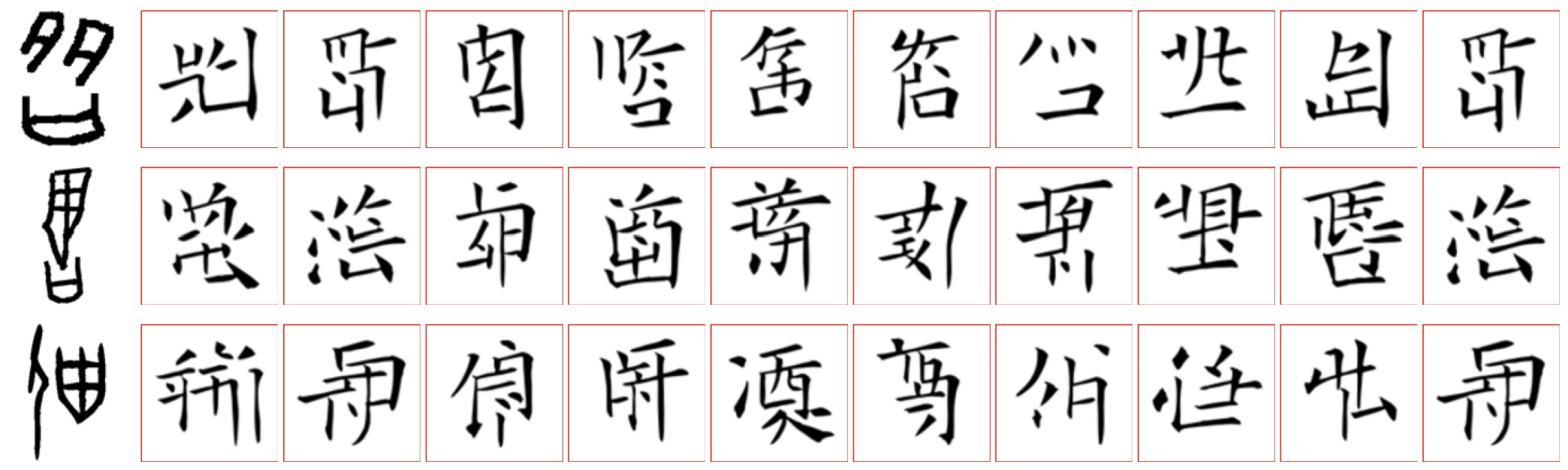
Deciphering Oracle Bone Language with Diffusion Models (conference paper, ACL 2024), by Haisu Guan, Huanxin Yang, Xinyu Wang, Shengwei Han, Yongge Liu, Lianwen Jin, Xiang Bai, and Yuliang Liu, won the outstanding paper prize at ACL 2024. It deals with the Oracle Bone Script (OBS) dating from China’s Shang Dynasty approximately 3,000 years ago, and one of the earliest scripts in the world. This paper introduces a novel approach by adopting image generation techniques, to use modern Chinese characters’ structures and its structural correspondence to OBS. To validate its efficacy, extensive experiments were conducted on an OBS dataset, with quantitative results demonstrating the effectiveness of the method.

Datasets Published
Corpus Bootstrapping for Syriac Linguistics (Journal of Open Humanities Data), by Charbel El-Khaissi, presents a corpus of ca. 475,000 words and covering Syriac texts from the entirety of the first millennium CE, annotated using the SEDRA API mechanism. The article summarizes the approach taken to create the dataset.
Conferences and Call for Papers
Upcoming Events
The final conference of the ERC-funded INSCRIBE Invention of Scripts and their Beginnings project, will take place on 11-13 September in hybrid format online and in Bologna (registration required for online and in person participation). Each day of the conference has a different theme: The Evolution and Invention of Writing; The Decipherment of Ancient Scripts; and State-of-the-Art Digital Humanities and AI applied to Ancient Scripts.
The Digital Arabia: The Online Corpus of Inscriptions of Ancient North Arabia (OCIANA) 2.0 Launch Workshop will take place on 12-13 September at Ohio State University. The workshop will explore the Online Corpus of Inscriptions of Ancient North Arabia, discussing the latest updates and advancements in ancient inscription research focused on Arabia. The online corpus (work in-progress) covers the inscriptions in the Ancient North Arabian alphabets used in the oases of Dadan (modern al-ʿUlā), Taymāʾ, and Dūmah (modern al-Jawf).
AKU-ISMC’s Centre for Digital Humanities (CDH) Virtual Open House will take place online on 17 September. This session is part of the KITAB project at the Centre for Digital Humanities at the Aga Khan University (International) in the United Kingdom. KITAB provides a digital toolbox and a forum for discussions about Arabic texts. CDH researchers will present a number of case studies based on the KITAB data and visualisations. Attendants will have the chance to explore data and texts related to their own interests.
The Friday Frontiers webinars of DARIAH include talks about current research, best practice and social impact, and different tools and methods in digital humanities scholarly practice. The first webinar on 4 October will hold a talk by Andreas Vlachidis, Julianne Nyhan, Andrew Flinn, and Alda Terracciano on: Innovations for a Unified Digital Collection: The Sloane Lab Journey to Unlocking the Past and Shaping the Future. Follow the link to register. Presentations are all recorded and published at a later date on DARIAH-Campus.
Call for Papers
The DARIAH Theme is a bi-annual thematic funding call for projects. The chosen topic for 2024 is Mistakes. They invite submissions that explore topics related to mistakes in Digital Arts and Humanities, including but not limited to error in data collection and curation, bias and discrimination in algorithmic systems, failure in the sustainability of digital projects, ethical considerations in handling mistakes, learning from mistakes, and more. Submission deadline is 30 September.
The first workshop of the Digital Methods for Mythological Research (dm4myth) will take place as part of the Computational Humanities Research Conference (CHR2024) in Aarhus, Denmark on December 3. The workshop aims to bring together a network of researchers from various disciplines and backgrounds working on research efforts such as the automatic or semi-automatic analysis and modeling of mythological narratives, comparative efforts using digital tools, or the study and representation of mythological characters. Contributions are welcomed from various humanities disciplines, such as ancient Near Eastern studies, religious studies, classics, archaeology and art History. Submission deadline is 1 October.
Did we miss relevant articles published in the previous month? Did we miss upcoming events in the next month? Would you like to ensure your news will appear in the next newsletter? Please send us an email at digpasts@gmail.com! Corrections to published Newsletters will be sent via the DANES mailing list.