
DANES Newsletter - February 2025
Now is the time to make your summer plans! There are no less than four summer schools and training workshops for gaining experience and skills with methodologies from the digital humanities, an excellent opportunity from beginner to advanced practitioners of the art to augment their toolbox. Furthermore, deadlines for summer conferences are approaching, including the DARIAH Annual Event on 17–20 June in Göttingen, dealing this year with “the past”; DANES 25, taking place in Ghent and Brussels between the 15-18 of September; and the 2025 Connected Past conference held in Coimbra, Portugal from 16-19 September.
This month’s newsletter includes new publications that show the benefits and importance of structuring data computationally for further quantitative research and analysis alongside transparency and reproducibility of research results. Lastly, the new Archibab 2.0 has launched! This long-awaited updated version provides a streamlined interface and linked data properties for exploring and discovering the immense corpus of Old Babylonian Akkadian documents.
Recent Academic Publications
An Empirical Analysis of Polytheism (article, Quality & Quantity), by Laurent Gauthier, uses ancient Greek epigraphic sources from the Base de Donnée des Epiclèses Grecques (BDEG) to quantitatively and empirically study distribution of votive acts across divinities and poleis. It shows that worship acts among gods follow power laws and do not seem to be affected by the particular characterizations of different polities.
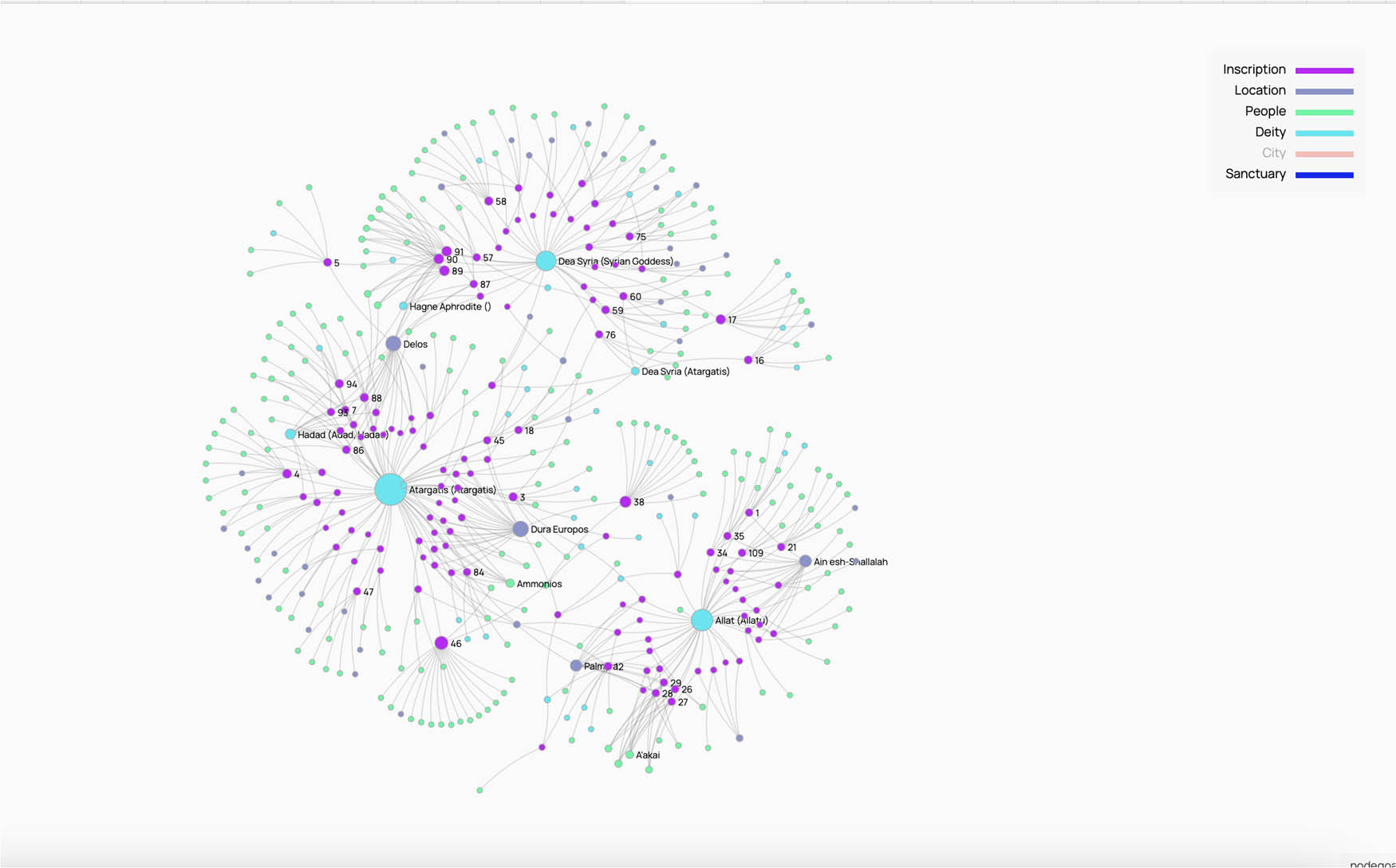
Goats and Goddesses. Digital Approach to the Religioscapes of Atargatis and Allat (article, Open Archaeology), by Aleksandra Kubiak-Schneider and Sebastien Mazurek, employes the NodeGoat research environment to structure and visualize the epigraphic data concerning ancient people, their ties with places, gods, and with each other. They describe the structure of their database, followed by a geographical and social analyses of the spread of religious practices, contrasting the worship networks of two contemporaneous goddesses, Atargatis and Allat.
Linked Data for Digital Humanities (book, Routledge), by Terhi Nurmikko-Fuller, illustrates in non-specialist language how data can be captured and interpreted in linked data systems, and made accessible online. Each chapter addresses issues and challenges with linked data, such as privacy and ethics, working with unstructured, messy, or biased data, ontology development and database design, and more. Chapters also include case studies from different periods and genres, one of them being Old Babylonian Sumerian literary texts.
The Ludii Games Database: A Resource for Computational and Cultural Research on Traditional Board Games (article, Digital Humanities Quarterly), by Walter Crist, Matthew Stephenson, Éric Piette, Cameron Browne, introduces the Digital Ludeme Project, an ERC-funded research project devoted to computational study of traditional strategy games, from 3,500 BCE onwards. The article presents how they model board games computationally, even when the full rules of the games are unknown. Thus they will be able to run AI simulations to reconstruct missing game knowledge, as well as study the evolution of how human game changed over time. To date, they have documented 1,058 board games.
Using Kart and GitHub for Versioning and Collaborating with Spatial Data in Archaeological Research (article, Archeologia e Calcolatori), by Andrea Titolo and Alessio Palmisano, provides a case study for using Kart, a version control method for GIS data, that is also integrated with QGIS software. Version control is immensly useful for remote collaborations and for following Open Science principles such as transparency, and this article emphasizes this by using Kart to fill a current gap in computational archaeological studies using GIS, in the context of preparing and digitizing archaeological data for the project ‘Governance Policies and Political Landscapes in the Southern Levant under the Neo-Assyrian Empire’.
Special Mention
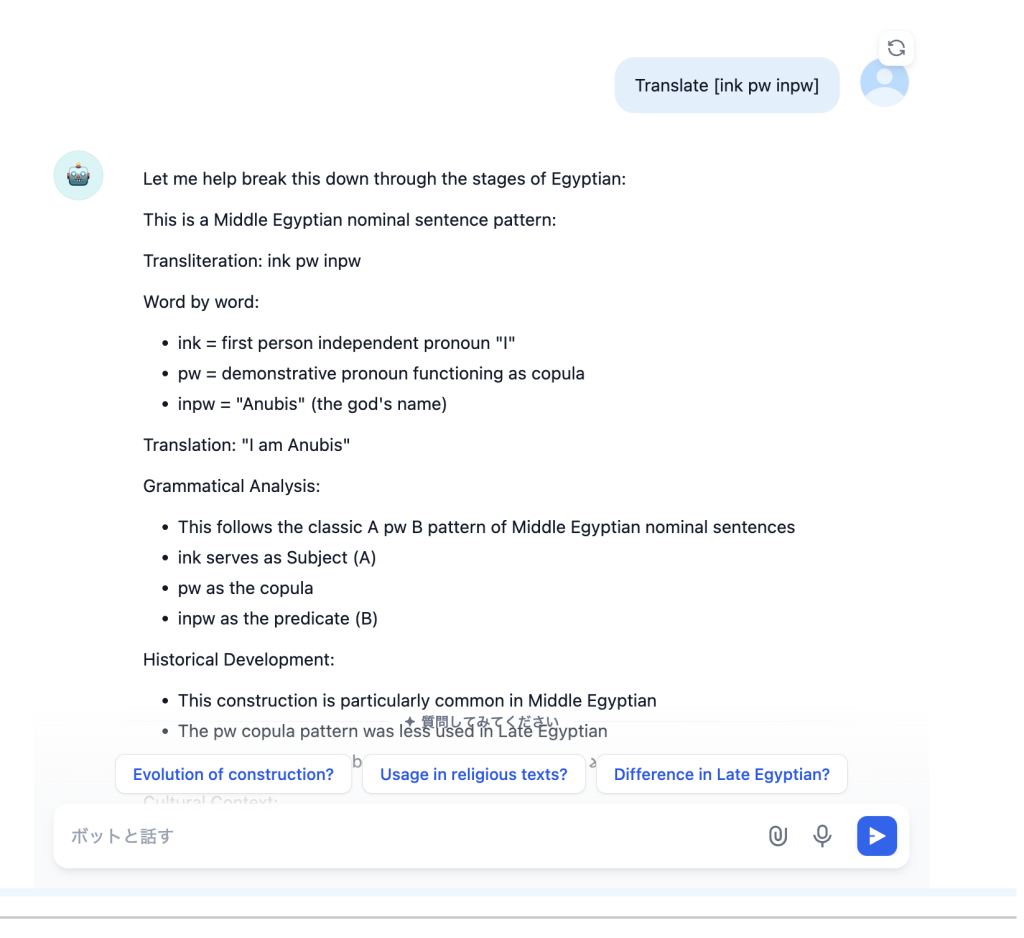
THOTH: Ancient Egyptian AI Teacher (AI tool), by So Miyagawa, is an AI bot interface that can explain Ancient Egyptian and Coptic grammar and translate them into English or other major languages. It can even do a transcription of Coptic from a picture of printed texts. It should, of course, be used wisely and carefully. Human discretion and evaluation is highly encouraged!
Conferences and Call for Papers
Upcoming Events
The Digital Classicist Berlin seminar series, organized by the Ancient World at the Berlin-Brandenburg Academy of Sciences and Humanities and the Berliner Antike Kolleg, continues this academic year (2024/25) with the theme: “Make data visible!” It takes place on every other Tuesday at 16:00 CET in-person and on zoom. This month Marian Dörk (FH Potsdam) is giving the talk: From Data to Dialogue. Exploration and Narration in Visualizations of Cultural Collections (4 Feb).
Sunoikisis Digital Classics or SunoikisisDC is an international consortium of Digital Classics programs, that offer online collaborative courses that foster interdisciplinary paradigms of learning of the ancient world. Currently based at the Institute of Classical Studies in London, they are offering several online courses this upcoming month that are of interest to the DANES community. The courses are streamed on YouTube and can be watched live or at a later date.
- Digital editions of inscriptions and papyri (6 Feb). Speakers: Gabriel Bodard (University of London), Marta Fogagnolo (University of Bologna)
- Working with Wikipedia (13 Feb). Speakers: Gabriel Bodard (University of London), Kate Cook (King’s College London), Richard Nevell (Wikimedia UK), Katharine Shields (King’s College London)
- Analysing and visualising texts (27 Feb). Speakers: Kaspar Beelen (University of London), Gabriel Bodard (University of London), Megan Bushnell (Oxford Text Archive)
- Working with Cuneiform texts (6 March). Speakers: Seraina Nett (Copenhagen University), Émilie Pagé-Perron (University of York), Rune Rattenborg (Lund University), Katharine Shields (King’s College London)
- Text Alignment (13 March). Speakers: Megan Bushnell (Oxford Text Archive), Chiara Palladino (Furman University), Farnoosh Shamsian (University of Leipzig)
- Papyrological texts and linguistic research (20 March). Speakers: Marja Vierros (University of Helsinki), Polina Yordanova (University of Helsinki)
Summer Schools and Workshops
The Roy Rosenzweig Center for History and New Media invites applications for the next four workshops offered by the Mathematical Humanists project. Mathematical Humanists is offering a series of workshops (taking place in July-August) on the mathematics that underpins common digital humanities (DH) methods, developing a conceptual foundation for understanding the assumptions made in common DH methods. This summer’s workshops include Discrete Mathematics, Statistics, and Graphs and Networks workshops happening online, and the Linear Algebra workshop happening in person at George Mason University. Applications are due February 15. See more information on their website.
Illuminating the Past Summer Institute offers a course this summer (June 15–21) on advanced imaging techniques, 3D modeling, and image processing. It is hosted by the Videntes and the Center for Research Frontiers in the Digital Humanities at the University of Colorado. Participants will recieve hands-on experience with multispectral imaging and other groundbreaking technologies. People from all background and academic career levels are welcomed, and stipends are available to cover travel expenses etc. for US-based scholars. Application deadline is February 15 via this form.
The Digital Humanities Summer Institute (DHSI) is one of the biggest annual digital scholarship training institute and annual digital humanities conferences, taking place this year at the Université de Montréal (Canada). They offer thirty-three courses over two weeks (26-30 May and 2-6 June) on common DH methodologies for beginning and advanced audiences, and each participant can pick one course per week. Early registration ends on 31 March; scholarship are available and the application deadline is 1 March. See more information under their Registration & Fees page.
The Sixth Baltic-Adriatic (BAL-ADRIA) Summer School on Digital Humanities is taking place this year at the University of Zadar (Croatia) on 16 June–6 July, with one week taking place in person and the rest online. It is intended for doctoral students and professionals working in heritage, cultural, and academic institutions, and aims to equip participants with knowledge and expertise in digital methods and tools such as data scraping and analysis, text/corpus analysis, network analysis, image analysis, applications of AI, and GIS. Participants will engage in collaborative workshops, lectures, and supervised group work. Application deadline is March 17; see registration information.
Call for Papers
The Digital Research Infrastructure for the Arts and Humanities (DARIAH), the central European body governing DH research and pedagogy, organizes the DARIAH Annual Event whose theme this year is The Past, taking place on 17–20 June in Göttingen (Germany). They encourage paper, panel, posters, and demos submissions that leverage Digital Humanities approaches to analyze, interpret, and present historical and archaeological data, such as digital archiving and preservation, big (historical) data analysis, applications of VR and AR for recreating historical environments and experiences, spatial explorations of the past, the impact of digital humanities on teaching and learning about the past, and more. Application deadline is February 28.
The 2025 Connected Past Conference will be held in Coimbra, Portugal from 16-19 September. This conference continues the tradition of bringing together researchers exploring the application of network science and network theory in history, archaeology, and related disciplines. It welcomes contributions on topics such as the use of network science to model historical and archaeological phenomena, investigate social, economic, political, or spatial networks, engage critically with network theory in the context of humanities research, present new tools and datasets of historical and archaeological networks, and more. Submission deadline is 15 March.
The third DANES conference, Bytes and Bygones – Digital and Computational Analyses of Ancient Cultures, will take place this year at Ghent and Brussels from 15-18 September. Organized by the CUNE-IIIF-ORM and the Digital Ancient Near Eastern Studies (DANES) network, the conference is open to anyone studying ancient or historical cultures by applying digital or computational methodologies. Sessions will be organised around three main tracks: digitisation, language technology, and image analysis. Under these topics are included digital data publishing and sharing; International Image Interoperability Framework (IIIF); language modelling; stylometry; network analysis; optical character & handwritten text recognition (OCR/HTR); geospatial analysis and Geographic Information System (GIS); linked open data (LOD); natural language processing (NLP); ancient language processing (ALP); image feature annotation & analysis; photogrammetry; diversity, equity and inclusion (DEI) framework; and Gaming. Submission deadline is 21 March.
Did we miss relevant articles published in the previous month? Did we miss upcoming events in the next month? Would you like to ensure your news will appear in the next newsletter? Please send us an email at digpasts@gmail.com! Corrections to published Newsletters will be sent via the DANES mailing list.