
DANES Newsletter - December 2025
As the year comes to a close, this month’s newsletter has the highest number of publications so far! Moreover, the DH community has started its own Anthology of Computers and the Humanities, which offers an open-access, digital archive that hosts peer-reviewed conference papers from digital humanities conferences and workshops. The archive is indexed across the most popular scholarly indices and include support for persistent DOIs (digital object identifier). This is similar to the ACL Anthology, a peer reviewed open-source digital archive for the scientific literature of computational linguistics and natural language processing (NLP), and an important step closer for our own fields towards the best practices of computer science publications. The venues for publications expend including all type of contributions, like articles, data publications, methodological papers, etc., making sure that all stages of digital and computational work can get proper academic credit!
We also welcome all the recurring training opportunities by members of our network, note especially the upcoming Digital Applications in Assyriology Nordic Summer School 2026. Many leading DH conferences have opened Call for Papers, note especially the close deadline for DH2026 in South Korea. A growing presence of the DANES members in these central events will raise awareness to the contributions and challenges of studying ancient cultures computationally.
Recent Academic Publications
Two proceedings were published in the past two months, that are relevant to the DANES community. The first is the proceedings of the Computational Humanities Research 2025, which will take place on 9-12 December (see further below under Talks and Conferences). They published their proceedings before the conference itself, available on a new open-access publication venue, Anthology of Computers and the Humanities. Contributions that might be of particular interest to DANES members include:
- Automatic Named Entity Linking for Ancient Greek with a Domain-Specific Knowledge Base, by Marijke Beersmans, Evelien de Graaf, Alek Keersmaekers, Mark Depauw, Tim Van de Cruys, and Margherita Fantoli
- Between Woolf and Homer: An Explorative Approach to Intertextuality Detection using Large Language Models, by Nicolas Werner and Nils Reiter
- Echoes of Antiquity: Towards Understanding History through Human and LLM-Based Classical Text Translations, by Phillip Benjamin Ströbel and Felix Klaus Maier
- Embedded in the Labyrinth: Investigating Latin Word Senses through Transformer-Based Contextual Embeddings and Attention, by Vojtěch Kaše, Sarah Lang, and Petr Pavlas
- Semantic Search for Ancient Inscriptions, by Micah Tongen, Sara Sprenkle, Rebecca Benefiel, and Trevor Stalnaker
- The Latin Language Evolved Over Time, Masked Models Disregard That, by Miriam Cuscito, Alfio Ferrara, and Martin Ruskov
- Towards a Computational Study of Ancient Greek Rhyme, by Keith Begley and Leon Wash
- Transmission and Survival of Iberian Patristic Texts (3rd–5th Centuries), by Émilie Guidi, Théo Moins, and Jean-Baptiste Camps
Another annual conference that took place in September recently published its proceedings: INFORMATIK 2025: The Wide Open - Offenheit von Source bis Science. It was devoted to discussing open access and open processes in an increasingly digital world that is interconnected through information systems. It also included a workshop on Digitalization of Cultural Heritage, in which the majority of the articles below were presented:
- Adapted 2D QR-Code for Cuneiform Tablets Digitization, by Ann A. Jarjes Alkazzaz and Ghassan J. Mohammed Aladool
- Computer Vision in Archaeology: Automated Cuneiform Recognition and Pronunciation, by Elaf A. Saeed, Ammar D. Jasim, and Munther A. Abdul Malik
- Designing an Interactive Database for Preserving the Heritage of Mosul City, by Mohammad Aldabbagh, Abdullah Sulaiman, Omar Al-Khalidy, and Latif Abbas
- Global Historical Routes as a Tool for Disseminating and Preserving Cultural Heritage, by Sumaya Alsaffar and Zinah Abdulrahman
- Preserving Heritage Using Photogrammetry and Virtual Reality: A Virtual Museum for Jebel Al-Barkal, by Lina Alhaj
- Sharpness Enhancement of Archaeological Images Using Grimaldo-Levin Networks with Unsharp Masking, by Zohair Al-Ameen and Basim Mahmood
In addition, two edited volumes were recently published:
- 3D Research Challenges in Cultural Heritage VI: DigitalTwin versus MemoryTwin (book, Springer), edited by Marinos Ioannides, Eleanor Fink, Janet Anderson, Antonella Fresa, Antony Cassar, and Sander Münster
- Evolving Perspectives on Digital Classics (book, Routledge), edited by Clelia R. LaMonica and Anna Foka
And finally, as always several articles in leading journals came out, showcasing the importance and possibilities of computational methods and ANE data:
- Bayesian analyses of radiocarbon dates suggest multiple origins of ceramic technology in Early Holocene Africa (article, Nature Communications), by Rocco Rotunno and Enrico R. Crema
- DeepScribe: Localization and Classification of Elamite Cuneiform Signs via Deep Learning (article, Journal on Computing and Cultural Heritage), by Edward C. Williams, Grace Su, Sandra R. Schloen, Miller Prosser, Susanne Paulus, and Sanjay Krishnan
- From fragments to digital wholeness: An AI generative approach to reconstructing archaeological vessels (article, Journal of Cultural Heritage), by Lorenzo Cardarelli
- Large Language and Multimodal Models in Archaeological Science: A Review (article, Electronics), by Xuekai Qi and Rui Wen
- MEHDIE: the Middle East Heritage Data Integration Endeavor (article, Digital Scholarship in the Humanities), by Tomer Sagi, Moran Zaga, Sinai Rusinek, Efraim Lev, Moshe Lavee, and Katja Hose
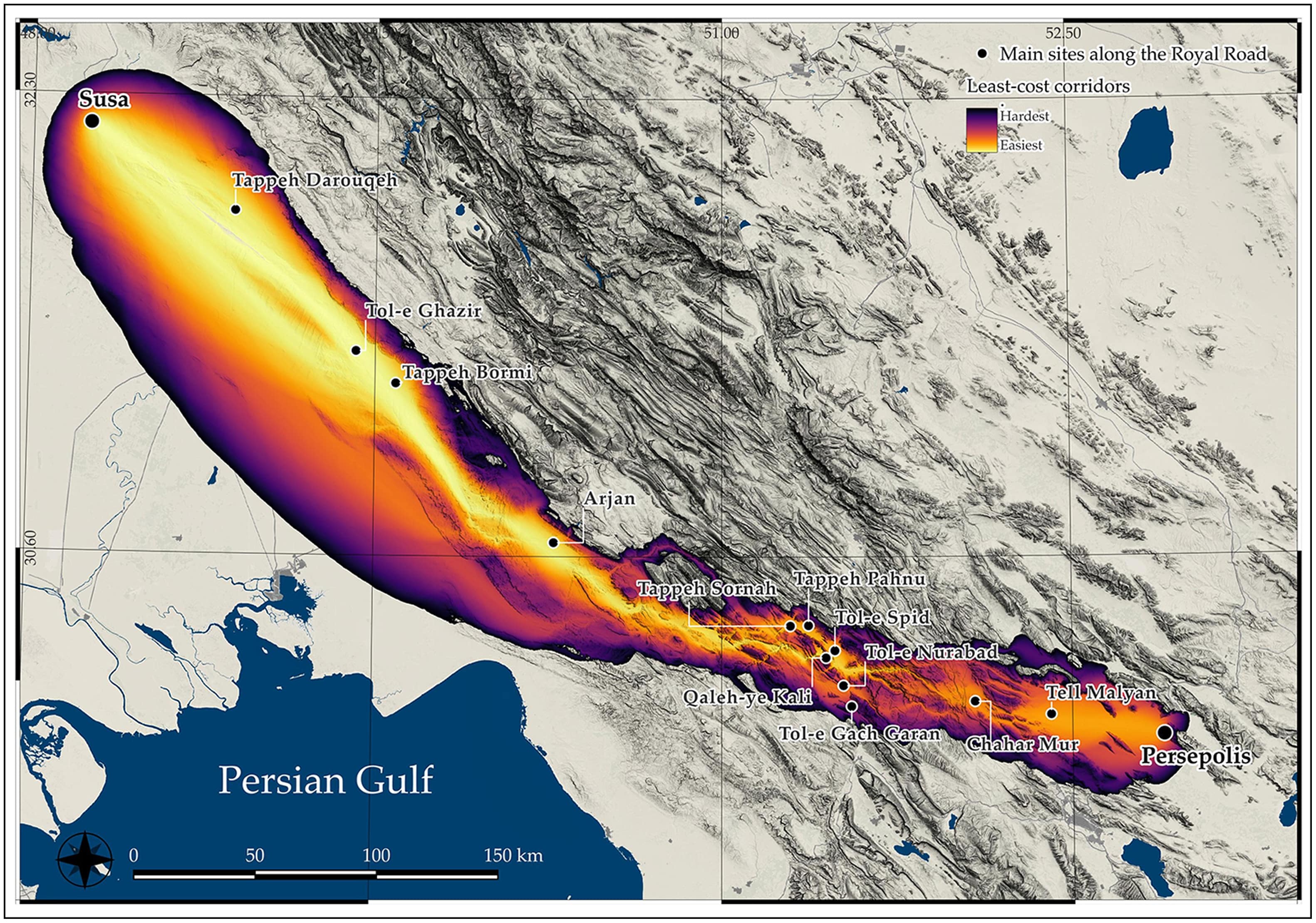
- ‘Royal’ road, ‘royal’ needs: a GIS-based approach to Achaemenid court logistics between royal capitals of Susa and Persepolis (article, Antiquity), by Davide Salaris
Special Mention
Using digital archaeology and machine learning to determine sex in finger flutings (article, nature), by Andrea Jalandoni, Robert Haubt, Calum Farrar, Gervase Tuxworth, Zhongyi Zhang, Keryn Walshe, and April Nowell, offers a new methodology to investigate those who left finger flutings on cave art. Finger flutings are distinctive markings, made by pressing or scraping fingers against soft sediment lining the walls, ceilings and floors of limestone caves. They are found at sites across Western Europe and Australia during the late Middle to Upper Paleolithic period, ca. 60,000–12,000 years before present (BP). In this research, they conducted an experiment with 96 participants who created new samples of finger flutings, and then trained a machine learning model on the known data to predict the sex of the person who made the fluting. While they did not reach reliable sex classification, additional tactile experiments showed potential, though they conclude more samples are needed.
Datasets Published
From Paginā to Webpage: On Developing and Documenting a Digitized Latin Collection (Journal of Open Humanities Data), by Stephen Bothwell, Kaitlin Stephan, Hildegund Müller, and David Chiang, present three Zenodo repositories related to the creation of digital editions of Latin texts.
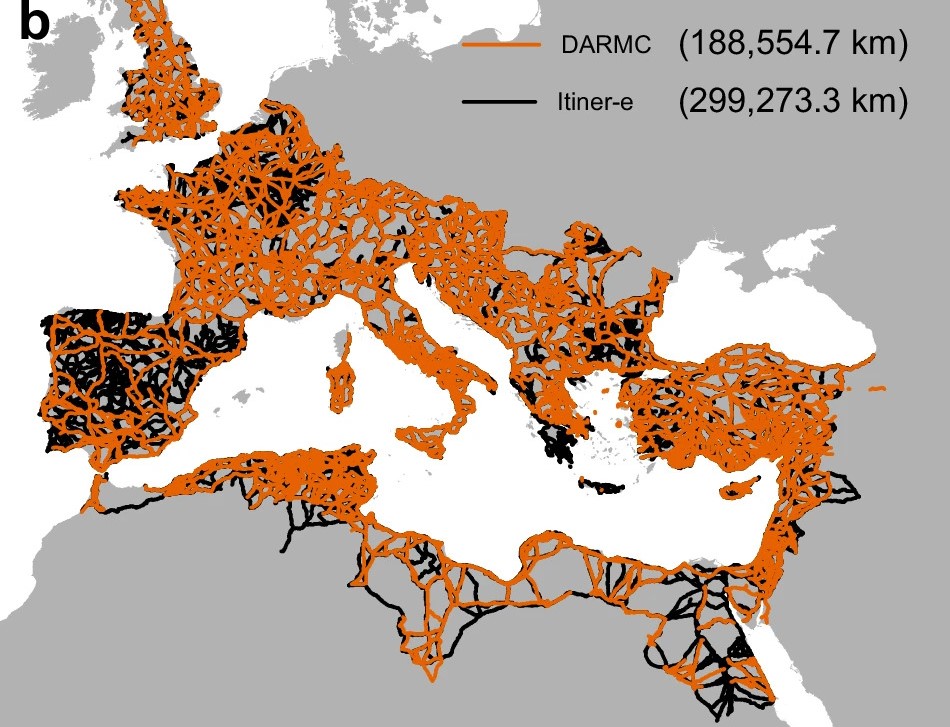
Itiner-e: A high-resolution dataset of roads of the Roman Empire (Nature Scientific Data), by Pau de Soto et al., a new detailed and comprehensive open dataset of roads in the entire Roman Empire. It was created by identifying roads from archaeological and historical sources, locating them using modern and historical topographic maps and remote sensing, and digitizing them with road segment-level metadata and certainty categories.
Raetia Prima in Long Late Antiquity (3rd–8th Century AD). A Georeferenced Dataset of All Archaeological Sites (Journal of Open Archaeology Data), by Annina Wyss Schildknecht, is an introduction to a dataset which comprises all known archaeological sites (settlements, burials, and churches) from the Long Late Antiquity in the Roman province of Raetia Prima.
Social Networks of Prosobab (Journal of Open Humanities Data), by Heidi Jauhiainen and Tero Alstola, created social networks from ca. 21,000 individuals attested in 5,000 cuneiform tablets, collected by the Prosobab project in a relational database. They prepared the dataset to make it easily accessible and suitable for social network analysis.
Events
Talks and Conferences
Linked Pasts Symposium 11 will take place online, 1-12 December. The symposium includes eleven branches or activities open for participation:
- 1-4 December: Pelagios Network People Activity: Sample Data Hackathon (Gabriel Bodard, Jun Ogawa)
- 1-4 December: SNAP:DRGN secondary recommendations: TEI XML and Wikidata (Gabriel Bodard, K. Faith Lawrence, Camillo Carlo Pellizzari di San Girolamo, Charlotte Tupman)
- 1-8 December: Promoting Collaboration, Linking Communities: building Pelagios connections through the Digital Classicist Wiki (Tom Gheldof, Sarah Middle)
- 2-3 December: Documenting Epigraphic Data in Wikidata: From Ontology to Practice (Anna Clara Maniero Azzolini, Maxime Guénette, Emily Helm, Anne Hunnell Chen)
- 2-3 December: Wikidata/CIDOC property mapping: discovery and planning (Anne Chen, Kimiko Adler, Katherine Thornton, Florian Thiery, Daria Stefan, Maxime Guénette)
- 2-4 December: Chronique en ligne/AG Online: First geodata hackathon (Catherine Bouras, Eleni Gkadolou)
- 3 December: Pelagios Network Annotation Working Group (Elton Barker, Anne Chen)
- 9 December: Linking Knowledge Through Place: ISHI, WHG, and the Future of Gazetteer Collaboration (Ruth Mostern, Stephen Gadd, Alexandra Straub, Palak Vashist).
- 9-10 December: Enriching digital heritage with LLMs and Linked Open Data (Gethin Rees, Elton Barker, Sarah Middle, Anna-Maria Sichani, Mia Ridge)
- 12 December: Writing SPARQL queries with GitHub Copilot (Duncan Hay)
- Reconstructing events in time and space (Yu Lee An, Ryan Shaw)
The Digital Classicist Berlin seminar series, organized by the Ancient World at the Berlin-Brandenburg Academy of Sciences and Humanities and the Berliner Antike Kolleg, continues this academic year (2025/26) with the theme: “Potenziale und Grenzen digitaler Methoden”, in hybrid format (zoom link). Talks in the next couple of months include:
- 2 December, Lily Grozdanova, Ulrike Peter, Claus Franke, Tim Westphal, Margareth Warburton: The ACCSN Initiative: Discovering the Potential of Digital Methods by Facing their Limits.
- 16 December, Raffaele Rizzo, Michele Pirro Leo, Vincenzo Ria: From Shovels to Servers: Three Perspectives on the Potentials and Limits of Digital Archaeology
- 6 January, Stylianos Chronopoulos: Capturing performance in graphs? Visualizing networks of Ancient Greek Comedy
- 20 January, Felipe Cinelli Barbosa: Network Science for the Interpretation of Ancient Texts: Prospects and Challenges Based on Two Biblical Test Cases
- 3 February, Eleni Bozia: AI-driven Classics: Potentials and Limits of Generative Methods
The Institute of Classical Studies in London is offering several online talks and workshops this upcoming month that are of interest to the DANES community. Upcoming events are:
- 2-3 December, Anna Clara Maniero Azzolini: Documenting Epigraphic Data in Wikidata: From Ontology to Practice
- 10 December, Miljana Radivojević: Community Detection in Archaeology: Testing Robust Algorithms on Early Copper Networks in the Balkans
- 10 December, Chiara Cenati: EpiDoc office hour
- 21 January, Ester Salgarella and Katharine Shields: Mediterranean Antiquity Digital Classicist Wiki Sprint
The Sixth Conference on Computational Humanities Research will take place at the University of Luxembourg, 9-12 December. Computational Humanities Research (CHR) is an international and interdisciplinary community that supports researchers with an interest in computational approaches to the humanities. The first day (9 December) is for pre-conference workshops. The themes and talks include all aspects of applications of computational methods to humanities data. The conference proceedings were already published (see recent publications above).
The London Centre for the Ancient Near East is hosting the Autumn Lecture Series 2025: Digital Humanities and the Ancient Middle East and Asia. The events are hybrid but registration through eventbrite is required for online participation. One talk is scheduled for December: Émilie Pagé-Perron, Linked Open Data in Cuneiform studies: present and future (15 December), see sign-up link.
Training Opportunities
The Digital Applications in Assyriology Nordic Summer School 2026 will take place in Helsinki, 1-5 June. The course is intended for students without much prior experience in the application of digital tools to the study of cuneiform sources or related materials. It will include hands-on training as well as lectures and discussions led by the teaching staff and invited speakers, as well as an independent project. The programs and tools introduced in the course include Excel, OpenRefine (tool for inspecting and cleaning tabular data), Python (programming language), Tableau (tool to visualize tabular data), QGIS (free and open source GIS), and Gephi (free and open source network analytical software). Participation in the summer school is free of charge, but students will have to cover their own travel and accommodation expenses. Accepted students from Erasmus+ partner universities will be able to apply for Erasmus mobility grants to cover (part of) their travel and accommodation costs. Application deadline is 14 December.
The Barcelona Past Networks Summer School 2026 will take place in Barcelona, 16-19 June. It offers hands-on training in network research for the study of the human past. Participants explore network theory, methods, and critical applications through practical exercises and expert-led lectures. No prior computational skills are required. If accepted, a 75 EUR lunch fee is required. A small number of bursaries is also offered. Application deadline is 26 January, see more details on their application page.
The Transnational Access Scheme Grants of the ATRIUM project is accepting applications for fully funded (travel, accommodation, and subsistence) placements across Europe for researchers. This initiative is designed to support Arts and Humanities researchers by providing access to expert knowledge, mentorship, and tools from leading Data Management organizations. It provides an opportunity to design your own research stay at one of eleven international ATRIUM host organizations (see list here). To apply, reach out to one of the host institutions and if they confirm interest, one can apply through their online form. Application deadline is 31 December.
Call for Papers
DH2026 is the 36th annual conference of the Alliance of Digital Humanities Organizations (ADHO), taking place in Daejeon (South Korea) and online, 27-31 July. It is one of the leading annual conferences in digital humanities. This year’s theme is Engagement, highlighting commitment to fostering meaningful connections—both among diverse communities and between humans and emerging technologies. This conference embraces both established areas of digital humanities and emerging approaches, encouraging discussions that critically and practically examine these technological developments and consider their impacts within the communities and contexts they shape. They also have three sub-themes: Translating | Translinguality in the Era of AI, Annotating | Beyond Patterns: Interpretation with Small Data, and Remembering | Digital Humanities and the Memory of the World, though submission from a broad range of topics within digital humanities are welcome. Submission formats include long and short papers, posters, and pre-conference workshops or mini-conferences. Application deadline is 8 December.
Nature Humanities and Social Sciences is holding a special collection: From bits of history to bytes of data: AI and the study of the ancient Near East. This collection aims at examining the computational and digital study of “greater Western Asia” and its epistemological implications. They invite contributions that consider one or more of the following methodologies for the digitization or computational study of ancient data, while answering or providing case studies to dive into epistemological questions: 3D documentation and visualization of artifacts (e.g. in extended reality environments); Ancient language processing and computational linguistics; Digital database design and implementation; Digital paleography and epigraphy; GIS and spatial analysis; Paleogeography and Paleoenvironment; Population history and DNA; Graph theory and network analysis; Knowledge organization and linked data systems. Submission deadline for full articles is 13 December.
The DARIAH Annual Event 2026’s theme is Digital Arts and Humanities With and For Society: Building Infrastructures of Engagement. The event is planned to take place in Rome, 26-29 May. The theme seeks to explore digitally-enabled research through a public and participatory lens, focusing on who our research is for, what are its social and public benefits, and how research can serve to create new dialogues within the public sphere. They are looking for scholarly reflections, concrete experiences and case studies, theoretical contributions, and policy considerations that examine how digital, social and institutional infrastructures can support engaged research, and nurture generosity, participation and shared creativity in the digital arts and humanities. See more details in the call for papers. Application deadline is 22 December.
Transformations, a journal by DARIAH, is sending out a Second Call for Contributions on Digital Past(s): Representation, Reconstructions, and Algorithmic Futures. Following the theme of the DARIAH Annual Event 2025, the journal looks for contributions that interrogate the fundamental nature of “the past” as it becomes increasingly mediated, represented and reconstructed through digital infrastructures, algorithms, and interfaces. Specifically, they are interested in contributions regarding topics such as digital storytelling and narratives of the past; the archaeology of digital approaches to the past; AI and big data in historical research; teaching the past through digital methods; and digital archiving and preservation strategies. They welcome research articles, data papers, and workflow papers. Submission deadline is 31 December (no extension is planned).
The 2nd Semantic Annotation for the Ancient World (SA4AW) conference, taking place at the University of Crete and online, 7-8 May, examines the role of semantic annotation in dialogue with hybrid AI approaches, large language models (LLMs), deep learning, and knowledge graphs in the study of the ancient world and cultural heritage. They welcome contributions that showcase methods, tools, case studies, theoretical reflections, and cross-disciplinary collaborations. In line with FAIR and Linked Open Data principles, the conference encourages open and accessible research practices. Application deadline is 1 Febrauary.
The EURALEX Conference 2026 theme is Lexicography in the Age of AI, taking place in Vienna and online, 29 September-3 October. With its theme, the conference aims to bring together professional lexicographers, linguists, publishers, researchers, software developers and anyone interested in dictionaries and their educational, cultural, political and social impact on everyday life. They invite papers (20 min), software demonstrations (10 min), and posters. Topics include dictionary types and formats , dictionary-making processes and methodology, dictionary use and user needs, corpora in lexicography, phraseology and collocations, lexicography and language technologies, data infrastructure and lexicographic tools, quality, ethics, and sustainability, lexicology and linguistic foundations, etymology and historical lexicography, dictionary design and publication, lexicography of lesser-used and under-researched languages, or collaborative and community lexicography. The program will also include pre-conference workshops, a book exhibition, and social events. Application deadline is 1 February.

Did we miss relevant articles published in the previous month? Did we miss upcoming events in the next month? Would you like to ensure your news will appear in the next newsletter? Please send us an email at digpasts@gmail.com! Corrections to published Newsletters will be sent via the DANES mailing list.